Hummingbirds of SE Arizona

Last Saturday, September 11, Barbara and I went to Southeast Arizona to look for the Plain-capped Starthroat (a hummingbird) that had been reported to be present regularly for the past several days at the Paton’s feeders in Patagonia.  We arrived about 4:00 p.m. and no one else was present.  Plenty of hummingbirds, including Black-chinned and Violet-crowned, were buzzing about, busily sipping at the dozen or so hummingbird feeders in the back yard. 

Black-chinned Hummingbird

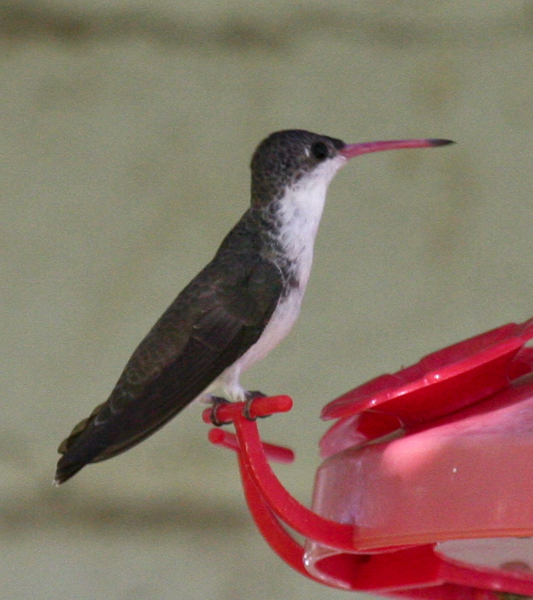
black-chinned-editedViolet-crowned Hummingbird

violet-crowned

Mike Marsden, who has assumed a caretaker role at the Paton home, came out to join us, and Al Hodges of Maine also came by.  Al was with me on a Wings trip a couple of years ago and it was a pleasant surprise to get together again.  As we were visiting, the Plain-capped Starthroat made a brief  appearance, and then disappeared for the rest of the evening.  Barbara was able to get a couple of quick shots showing the prominent white feathers which provide a reliable field mark for identification of the Starthroat. The Starthroat is quite rare in North America.  The American Birding Association rates it a 4 on its Checklist, just one shy of the really rare 5s.

Starthroat

star-throat

I mentioned that one of my nemesis birds has been the Lucifer Hummingbird, (only a 2 on the ABA Difficulty Checklist) which I have searched for in Texas a couple of times in prior years, with no success.  Mike said it should be no problem finding them at Mary Jo’s.  Mary Jo is the host of Ash Canyon Bed & Breakfast south of Hereford, AZ.  We revised our plan for Sunday and drove to Sierra Vista to find a hotel for the evening.  Sunday  morning we drove south to Mary Jo’s where we arrived early in the morning to be greeted by a flock of very large and very tame wild turkeys strolling through her yard.  We watched the furious hummingbird activity at her feeders for a while.  Mary Jo came out and sat with us, and it was not long before both male and female Lucifer Hummingbirds appeared. 

Male Lucifer Hummingbird

lucifer-male

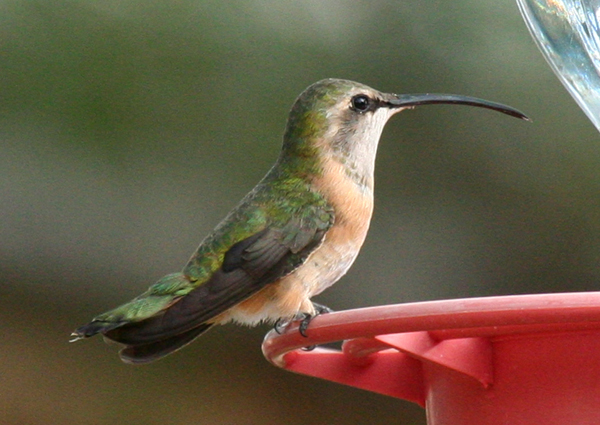
Female Lucifer Hummingbird

lucifer-female

Yeah!!! Two North American life birds (Nos. 688 and 689) for the trip when I had only expected one.  We saw perhaps a half-dozen of them during the morning.  She tells us that they have established a significant breeding territory in the easter Huachucas over the past 10 years and that there are about 150 pairs now in the area.

Broad-tailed, Magnificent and beautiful Broad-billed hummingbirds passed through the feeder setup, along with innumerable Anna’s.

Broad-billed Hummingbird

broad-billed

Mary Jo was leaving to spend the morning hummingbirding at a neighboring B&B, Beatty’s in Miller Canyon.  Beatty’s is a bit higher and has some species of hummingbirds that do not show up at Mary Jo’s.  After we had absorbed as much of the hummingbird activity as we cared for at Mary Jo’s (we were hoping for the appearance of a Calliope Hummingbird, which had been seen there once or twice on previous days but not this day), we followed her directions to Beatty’s and were  welcomed by the Beatty family.  We spent an hour or so in their lovely hummingbird garden  where we were able to view several Blue-throated Hummingbirds.   A highlight was a nest with 2 young Blue-throated Hummingbirds nearly ready to fledge. 

Blue-throated Hummingbirds

blue-throated

No Berryline Hummingbirds made their appearance, so I will have to wait for a future trip to add that one to my life list.  They had been regular at Beatty’s but it is late in the year and they seem to have moved south.  We did enjoy seeing several Rufous and Anna’s.

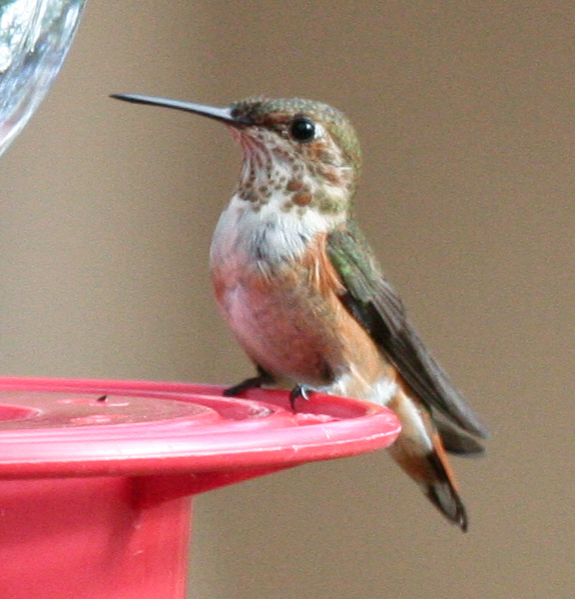
Rufous Hummingbird

rufous

Anna’s Hummingbird

annas

That afternoon we drove to the San Pedro House east of Sierra Vista and hiked along the San Pedro River.  I think I was stung by a really potent insect during the walk and had some uncomfortable chest congestion for the remainder of the day.  We were able to spot a couple of good birds on that walk, including a Blue Grosbeak and a Vermillion Flycatcher.

Cuban Pewee in Florida

The Rare Bird alerts were going wild last week with the reports of a very rare Cuban Pewee in the Florida Everglades.  There have been only 3 prior confirmed sightings of this species in North America.  We decided to go try to find it.  Our search for the Cuban Pewee would be supplemented by the possibility of a Western Spindalis, reported seen on September 6 and 7,  in the same general area where the Pewee was being seen. 

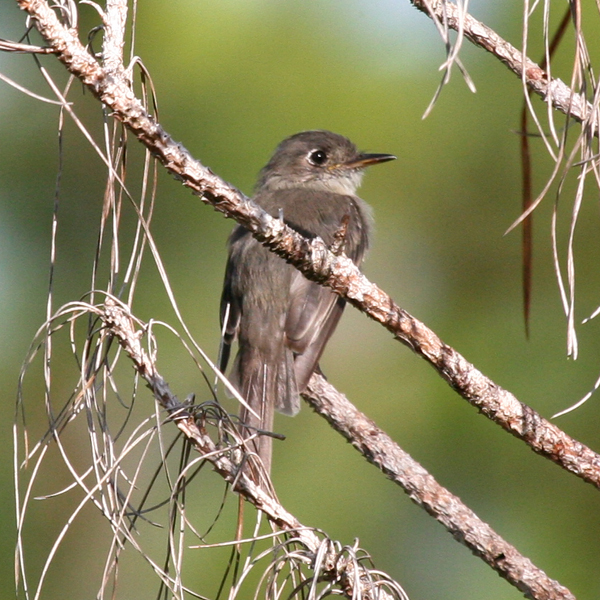
As soon as we arrived at the reported site, an excited birder motioned to us to come up a trail leading into the wooded area near Long Pine Key.  We followed instructions and were rewarded with an immediate view of the Cuban Pewee right above the trail.  The light wasn’t very good, but the view was sufficient.  However, we decided to try for a better look the next morning.  When we returned the next morning there were a dozen or so birders already on site.  Soon one came running up the road to report the Pewee was perched about a quarter of a mile down the road.  Everyone scurried to the location, slightly off the road, and we were all rewarded with terrific, close-up views of the Pewee, in good light.  Some of the photographers went annoyingly close to the bird, but he stayed throughout the commotion.  Barbara got some good shots from a distance.  Although we did not hear the Pewee give its distinctive call, the prominent half crescent behind the eyes,  the unusually large bill,  the wingbars and the absence of tail-flicking were determinative. 

Cuban Pewee

cuban-peewee

After looking at the Pewee for as long as we wished, we moved off to try to find the Spindalis, with no luck.  (The Western Spindalis is a relatively new name for what was previously called a Strip-headed Tanager).  No one else has reported seeing it after September 7.  The “locals” tell us that the Spindalis nested in the vicinity last year and fledged a couple of young.  It was kept quiet to avoid any unnecessary nest disturbance by over exuberant birders or photographers, a very good precaution, I might add. 

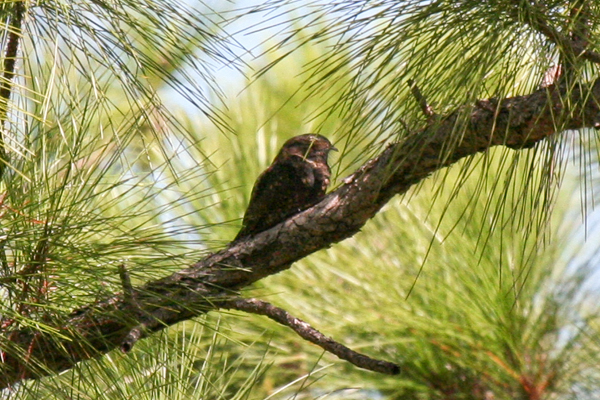
While looking for the Spindalis, another birder spotted a Chuck-will’s-widow, primarily a nocturnal bird,  perched on a horizontal branch not far from the road.  I have never seen this bird before in daylight.

Chuck-will’s-widow

chuck-wills-widow

A young couple from Indiana encouraged us to go look for the Plain-capped Starthroat which was being seen regularly in Arizona, so we have deceided to try that sometime.  They thought the Starthroat was a much nicer find than the Pewee, but I am sure others would dispute that. 

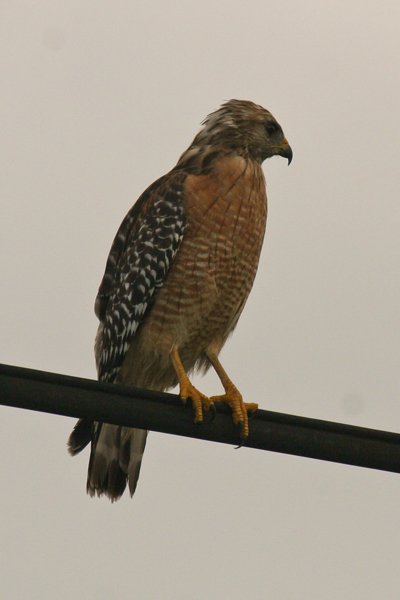
Encouraged by attacking mosquitoes, we left the Everglades Park and  drove down an old road just outside the Park. Among the sightings there was a nice close-up of a Red-shouldered Hawk.

Red-shouldered Hawk

hawk

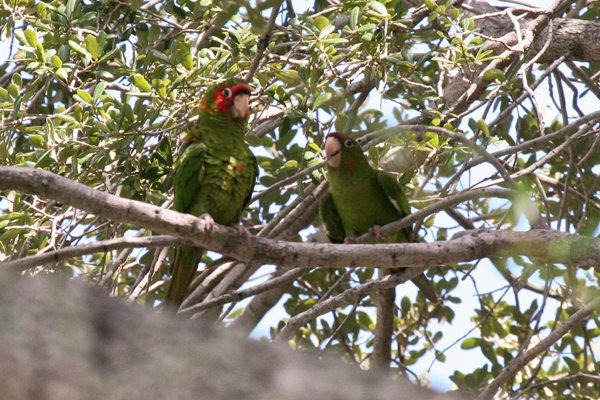
Having exhausted our “must see” list for the Everglades and vicinity, we headed to Miami to try for White-winged Parakeets.  No luck on the White-winged Parakeets, but the Baptist Hospital grounds in Kendall were loaded with colorful, noisy Mitred Parakeets.

mitered-parakeets

India 2010-Part 3

Monday, January 25

We had a leisurely morning in Khajaraho , no rush to get ready. After breakfast we walked around the beautiful grounds and gardens of the Lalit Temple View Hotel.  It occurs to us that labor is really cheap; many people work at keeping the grounds looking nice, using their hands only, no tools, to remove objectionable grass and weeds.  On to the airport at noon for our flight to Varanasi.  We are happy the flight is on time and going, since it has been cancelled the past 2 days due to fog.
 
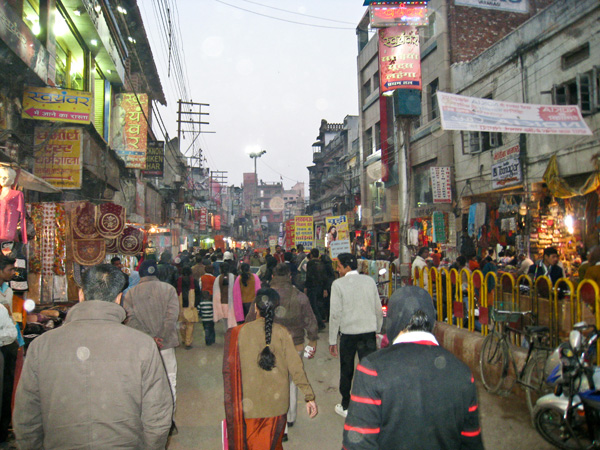
Varanasi is a bigger city of 2.8 million. The traffic is amazing with cars, bikes, motorcycles, rickshaws, tuk tuks, pedestrians, and cattle, all seemingly milling about the roads with no fixed destination. We are staying at the Taj Gateway Hotel. It is an old, large hotel with a very nice lobby and rooms. Late this afternoon our guide, Jai, came to get us at the hotel and with Raj, our driver, we drove toward the Ganges River. We got out of the car and walked a few blocks through the old market area, absolutely packed with people. 
 
Varanasi Street Scene
 
 
varanasi-crowds
 
We walked down the steps of the main Ghat to board a row boat which took us to the ghat where they were cremating about 20 people, each on a separate pyre. The sight, smell and sound was a bit overwhelming. After lighting a candle, making a wish (prayer) and floating it on the River, (being careful not to touch the water) we went back to the main Ghat to see and sit beside the 7 Hindu priests conducting a prayer (“Aarti”) to Mother River, with incense, fire and fans.
 
 
aarti-2
 
 
It was loud, colorful and long; quite a sight. Back to the hotel for a late dinner, mentally and emotionally exhausted from what we had just experienced.
 
Tuesday, January 26
 
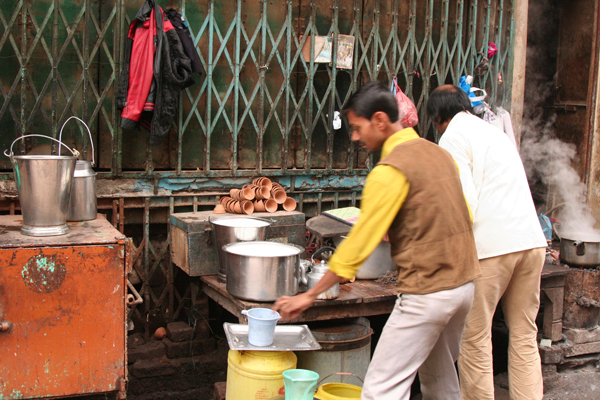
Today is Republic Day in India. It is one of their really big holidays, celebrating the independence of India from the British. For us, 4th of July would be the closest approximation. It is also a day of extraordinary security precautions at all Hindu temples and public places for fear of terrorist acts by Pakistani Muslim Fundamentalists. We arise early to go back to the Dashashwamedh Ghat to take a row boat the other direction, where we see Hindus worshipping and bathing in the river.  The weather is cool and foggy. We disembark, walk along the river bank, buy tea (chai) from a vendor, drink it from little clay cups, and then head back.
 
 
chai
 
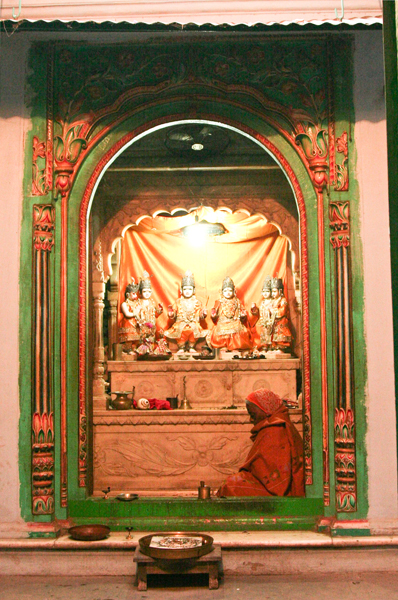
Numbers of people line the banks washing clothes in the river and beating them on the rocks along the side. They work very hard. We walked through alleys of the Old City with little shrines tucked in every few yards.
 
 
varanasi-temple
 
Barbara felt a little sick seeing even more poverty and awful living conditions. We walked on to see the Varanasi Golden Temple from outside its walls. Security is everywhere because of the holiday and Muslim bombings in the past. We had to check absolutely everything but our clothes and leave Jai to watch it before going near the Golden Temple.
 
Jai, who is a lawyer by education but makes his living as a guide, wanted to show us the University, so we drove through the campus on our way back to the hotel for a shower and breakfast. Early this afternoon Jai escorted us to the close-by city of Sarnath. This is where Buddha delivered his first sermon, under the Bo Tree. Sarnath is as sacred to Buddhists, who are now a small minority in India, as Varanasi is to the Hindus. It is surprising that so much has survived the various sackings it has undergone throughout the past 20 or 30 centuries. We walked around the ruins and through the Museum, which was very impressive, with its artifacts of Buddhism, some quite beautiful, dating back some 2,000 to 3,000 years. The Ashoka Pillar with 4 lions is the national emblem of India.
 
 
sarnath
 
Going off itinerary, Jai asked if we would like to visit a true Indian neighborhood, and we readily agreed. He took us to a little village where a number of the people specialize in the making of the little clay cups like we used for our tea at the Varanasi Ghat. The family we went to visit (Jai was well known to them) was very nice, and the kids enjoyed seeing their pictures on Barbara’s camera. The older lady invited us into her house. The kitchen had no light and the fuel for cooking was cow dung. The floors were dirt. There was a wooden shelf with a black and white television set and a DVD player. There were several small sleeping rooms.
 
Next stop was Bharat Mata-Mother India. It was inaugurated by Mahatma Gandhi and features a huge, floor mounted, marble relief map of the whole Indian sub-continent and bordering areas. Then on to a “quick” stop at Silk Ways to purchase a table cloth and 4 pillow covers. Back to the hotel. We really enjoyed Jai. He was friendly, spoke very good English, was very knowledgeable about many things and we felt that he really enjoyed working with us. He told us a lot about his own life and his family, which we found very interesting.
 
Wednesday, January 27
 
No alarm clock was set for this morning. We slept until 6:30. News reports show the worst fog in Delhi in 7 years. We worried about our flight there to connect with our road drive to Agra this afternoon. Seeing the Taj Mahal is an absolute must. We walked around the hotel grounds in the morning and then got a call from our local AK representative that our flight was not cancelled, but delayed an hour. Yipppeee! AK rep. Amid met us once again at the Delhi Airport and sent us on to Agra with our new driver, Badel. It seemed to take forever to get out of Delhi traffic, partly because our driver was not as aggressive in traffic as our prior drivers had been, and we think he got lost a couple of times. Then we stopped half way so he could take a break. We finally arrived at our Agra hotel, the Oberoi Armavilas, about 11:00 p.m. What a place! Everything about it is fantastic. We are on the 4th floor with what should be a perfect view of the Taj Mahal when we get up tomorrow morning.
 
Thursday, January 28
 
Dense fog greeted us once more this morning. We can only see a faint outline of the Taj.  After a very good breakfast, we now can see it from our balcony. Such a sight!
 
 
taj-mahal-4
 
The Hotel provided a golf cart and our Agra guide, Gupta, came to the Hotel and took us over to the Taj which is very close to the Hotel. As we walked through the main entry way and the Taj came into view, Barbara’s eyes filled with tears.  She was overwhelmed with its beauty and the fact that she was actually seeing it in person. The Taj was built by Shah Jahan in honor of his most beloved wife, Mumtaz Mahal.  Begun in 1631, it took 20,000 artisans and laborers to complete it by 1653.
 
 
taj-mahal-1
 
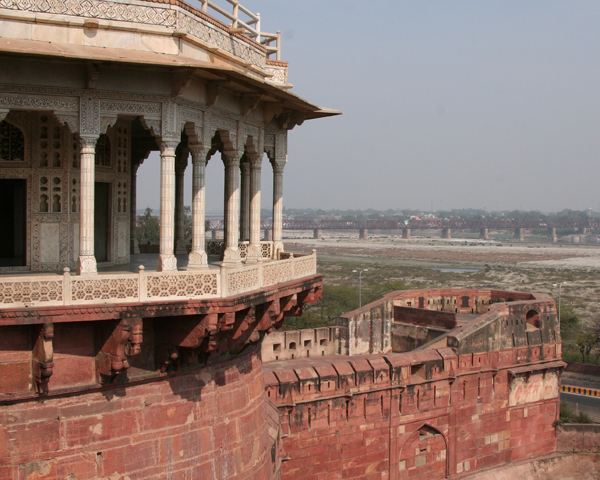
After a thorough tour, and many pictures, we went on to Agra Fort, another amazing structure, but made of red sandstone instead of white marble.  At the end of Shah Jahan’s life, he was imprisoned in this tower by his son, Aurangzeb.  From here he could see his Taj Mahal.
 
 
red-fort
 
Gupta is very good: knowledgeable, personable and helpful with the photography.  He could not believe that we knew John Shors.  His book, “Beneath the Marble Sky”, is very popular here.
 
We stopped during the afternoon at a very nice store where the 24th generation descendants of the Persian artisans brought to India by Shah Jahan to decorate the Taj Mahal, still ply their trade. We watched their meticulous labor for a while and then bought a marble table top inlaid with semi-precious stones. Then, back to the Oberoi for a late lunch and a short rest.
 
Early afternoon found us once again at the Taj Mahal basking in and reflecting the lovely late afternoon sunlight. The white marble and inlaid precious stones reflect the changing colors of the sky from sunrise to sunset.  The ever-changing shadows are beautiful. The engineering and craftsmanship are amazing.
 
 
taj-mahal-3
 
We return for “music” and “dancing” (not by us) by the pool at the hotel. We enjoyed dinner at the Hotel to the accompaniment of Sitar and Tabla music.
Wrens Leaving the Nest

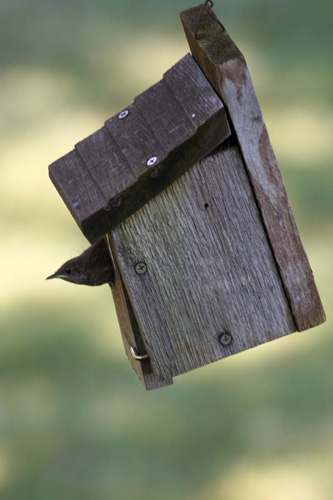
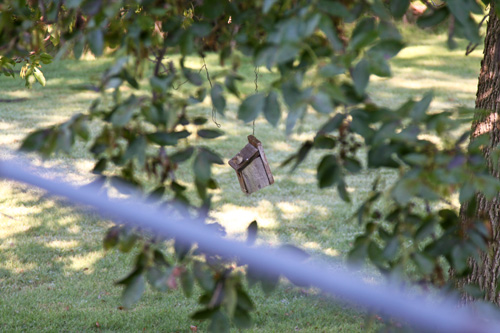
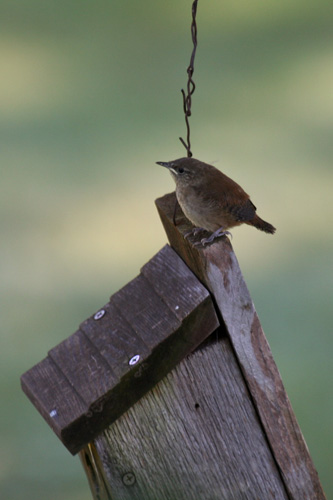
Our little house wrens left their nest this morning.

wren-4

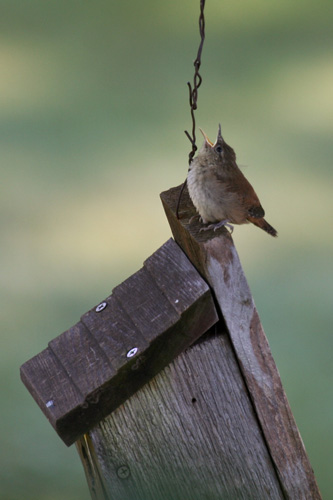
We were on our deck with our second cup of coffee this morning on the first cool, sunny and dry morning that we have had here for a long time.  We could hear the high school marching band practicing and reminisced about the years we enjoyed working with music and athletic booster clubs when our children were in school.  Those were wonderful years, but now we’re enjoying these “empty nest” years as well.  At about 9:00 a.m. a little wren poked its head out of the hole in its swinging home which dangles from a tree near our house, looked around for a few seconds,  and took off for the nearest perch, which happened to be our deck.  Camera time.

wren-1

wren-2

We watched as numbers 2, 3 and 4 quickly followed the little leader.  By 9:15 all 4 had appeared at their door and flown from the safety of their nest to the nearby cover of our woods.  It was a delightful 15 minutes.  We have had wrens nesting here for many years but never before have we witnessed the “fledging”.

May I have just one more meal before I leave home?

wren-3

The first flights of the little wrens reminded us that our lives are full of “fledgings” this year:  a granddaughter heading off to college for her first year; three granddaughters and a grandson starting high school; a grandson and a granddaughter starting kindergarten; and a brand new grandchild scheduled to see the light of day for the first time in two weeks.  So many wings being tried for the first time this year.

India 2010-Part 2

A few days ago I told about  planning our trip to India and traveling there.     In Part 2 I will summarize our experiences during the first few days of our tour of northern India.

Wednesday, January 20

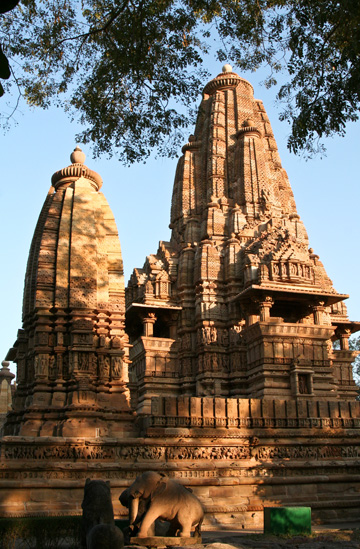
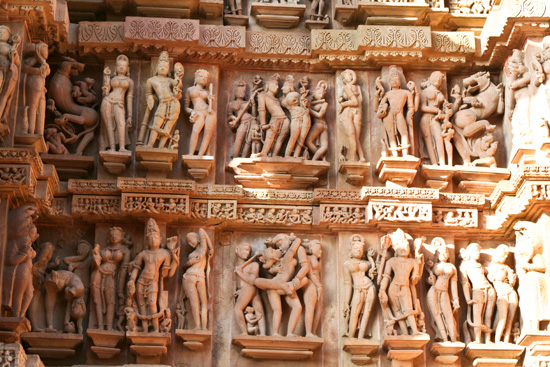
We arrived in New Delhi at 1:00 a.m. (12:30 p.m. on the 19th in Iowa), 51 hours after leaving our house. The AK representative, Amid, was there to meet us and take us to the Radisson. He was such a welcome sight and so helpful. This was supposed to be our day to tour Delhi, but because of the delays of our flights, we have postponed our Delhi sightseeing to the end of our trip.  After a very nice buffet breakfast at the Radisson, Amid and a driver took us to the airport to get our flight to Khajaraho. Our flight (on Jet Airways) was delayed, then cancelled due to fog. This fog is following us everywhere. We were rushed to the Kingfisher Airlines counter to get the last 2 seats on a flight leaving in 2 minutes. We sped through security, through the gates and onto a transporter to our plane.  Then we sat while the airport closed for one hour due to the fog. We were served lunch, and then waited some more. Finally, the plane took off for Khajaraho, with an intermediate stop in Varanasi. After arriving in Khajaraho 2 hours late, we were met by Ashok (the local AK representative) and Laksman (the driver) and taken to the Lalit Temple View Hotel. We were then met by our Khajaraho guide who took us on a tour of the Western and Eastern Temples. What a spectacular sight!

khajaraho-temple-1

Eighty five temples (twenty two remain) were built during the reign of the Chandella kings between 950-1050 AD.  The Indo-Aryan architecture is adorned with erotic carvings capturing life in all forms.

khajaraho-temple-2

Thursday, January 21 
 
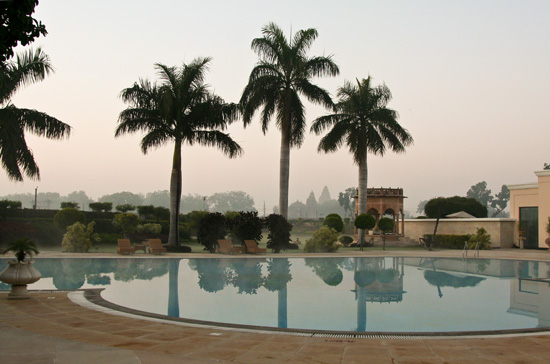
We rose early again, but what a treat because after we got ready for the day, we opened our
draperies and saw the Western Temples glowing in the morning sunshine above the pool atour hotel (hence the name, “Lalit Temple View Hotel”). We grabbed our coats and camera and went outside to enjoy the beautiful morning with no fog. Hurray!!

lalit-hotel

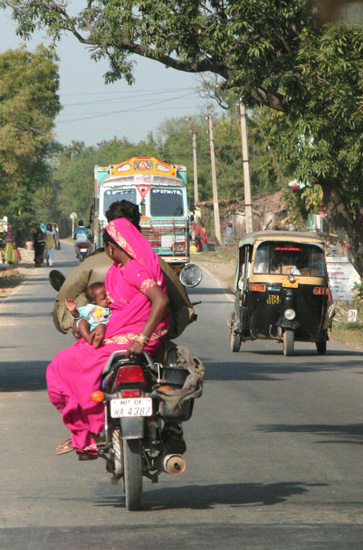
Breakfast at the Hotel, then off with the car to drive to Bandhavgarh National Tiger Preserve. This was a real eye-opening (6 hour) road trip. The roads are awful, and the driving was crazy, but our driver seemed very good. Town after town and village after village lining the “road”, nothing but people who just barely subsist. We saw many people carrying wood on their heads to use for cooking or heating. No running water; no electricity, village pumps for water. Children going to school, mostly in bright, neat uniforms. Most men seemingly doing nothing. Women working very hard and all dressed in colorful wraps (saris) and scarves. Cattle everywhere, some being herded, most wandering freely, including in the middle of the road and along all the streets. Everyone is thin and all the boys and men have nice haircuts. We have never seen so many bicycles and motorcycles, many with up to 4 persons on board.

street-scene-1

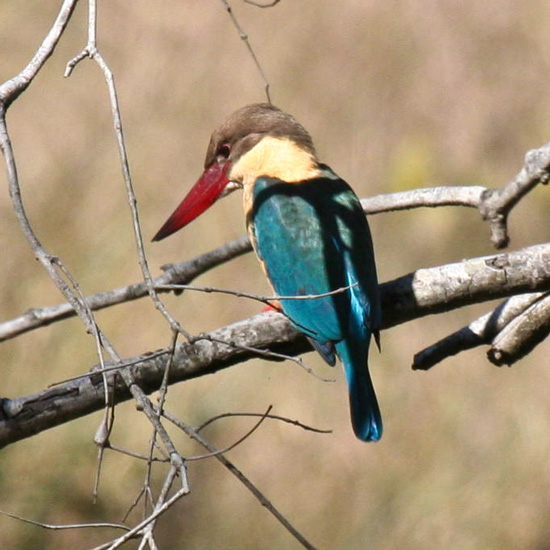
We arrived at the Tiger’s Den at Bandhavgarh in time for lunch and to drop our stuff in our room. On to our first game drive. We did not see a tiger, but we did see lots of spotted deer, several sambhar, wild boars, barking deer, common langurs, rhesus macaques and one jungle cat. We also saw several birds including this  Stork-billed Kingfisher. Back for dinner and off to bed.

stork-billed-kingfisher

Friday, January 22
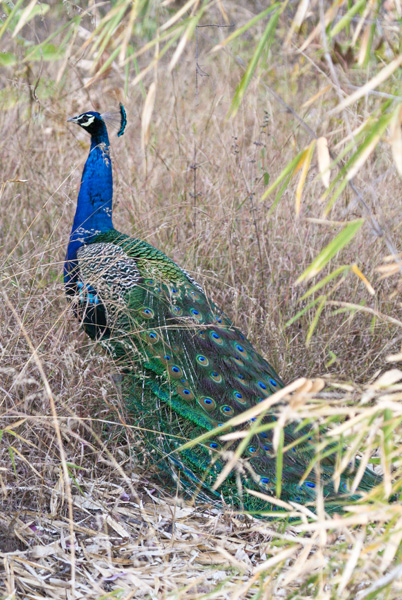
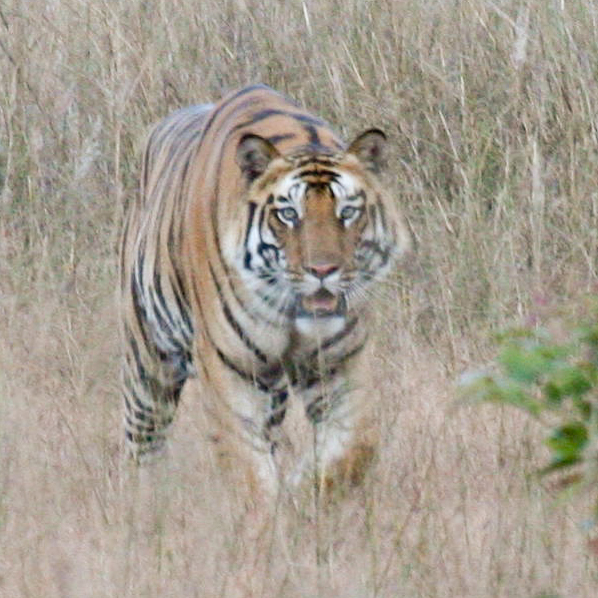
They brought coffee (Nescafe) and cookies to our room at 5:30 a.m. so we could be ready for our morning drive at 6:15. We did not see a tiger this morning, but it was nice to see the area. It is very cold here for this time of year, frost appearing on the ground. Back to the Den for a late breakfast. Out again for the afternoon drive at 2:15 p.m. Yeahhh!!! A Tiger. He is a 3-year old male lying in grass in the shade of a small tree. The lighting is not good for photography, but at least we got to see him. He rolled over, yawned, and went back to sleep. He was much bigger than we expected. We also saw more birds including many peacocks, the national bird of India, and a monitor lizard hibernating in the crevice of a tree. It has been a very successful day. 
peacock

Saturday, January 23
We were up early after Barbara’s first night of sleeping all the way through. Coffee and cookies arrived promptly at 5:30 and we were out on our morning game drive by 6:15, but no tigers this morning. The other vehicle from our camp saw one up close and got great photos. The afternoon drive was quite uneventful until the last minute when Jagat heard of a tiger spotting. Lots of jeeps were there watching the same tiger as the day before, named Kahula. He walked toward us following the elephants. He stopped laid down, rolled around and then settled down. WOW!!! A good day, after all. 

tiger

Sunday, January 24
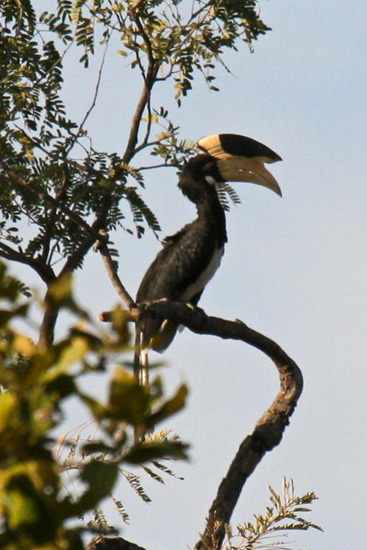
Instead of going on another game drive, we went to the Red Fort. It was such a nice morning and there was only one other vehicle there. We could see, at a great distance down on the plain, a tigress with 3 cubs, behind some trees along Route A. It was a little hazy but we could see a long way in every direction. We visited a temple with a priest. Saw a few Malabar Hornbills.

malabar-hornbill

Back for breakfast and an early lunch before driving back to Khajaraho through all the town and villages.  Near Satna we saw a parade of Jain priests and followers walking on (clogging) the road. Each priest was totally naked, in keeping with Jain tradition, and accompanied by a group of 20 or so followers, many wearing white robes. We learned from our AK representative on the trip that the Jain priests never ride in or on anything, but walk wherever they go. He thought they might be heading for some seminar or similar gathering. Finally back in Khajaraho, we checked in at the Lalit Temple View Hotel again and then walked down town for supper at a local restaurant, the “Raj”.  In India, we drank only bottled water, with no ice, so it was a very pleasant surprise to discover the local “Kingfisher” beer which is quite good and was usually cold. Even though Khajaraho is a relatively small village, the streets, as always, were crowded with walkers, bikers, cows and water buffalo, but we never felt uncomfortable except in trying to avoid stepping in chuck-holes and cow pies in the quite dark street. On our walk back to the hotel we were impressed by how dark India towns are at night. Most of the lighting that was on consisted of kerosene lamps or gas lanterns. Our flashlight is a necessity.

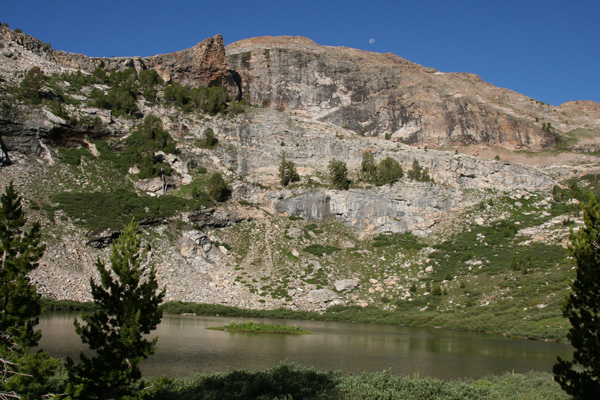
Himalayan Snowcock above Island Lake, Ruby Mountains

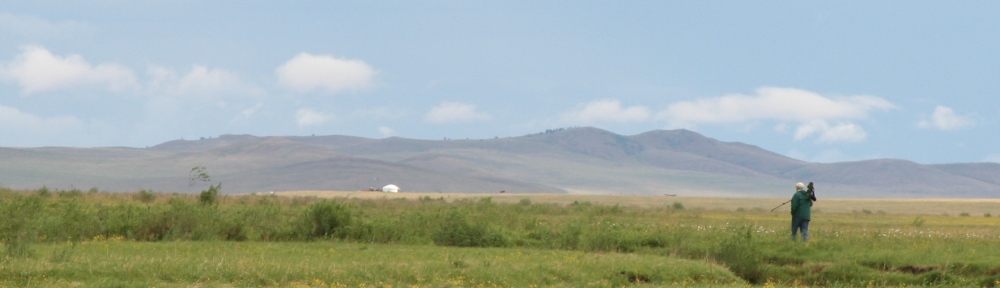
I went to Elko, Nevada, on July 29th, 2010, determined to see a Himalayan Snowcock, which hopefully would be # 684 on my list of North American birds.  Upon our arrival late afternoon on the 29th my wife and I hiked the well-marked trail from the parking lot at the end of Lamoille Canyon to the near side of Island Lake.  This was not a good idea. 

Because it was late in the day, from the lakeside, there was neither sight nor sound of a Himalayan Snowcock.  The scenery, however, was breathtaking.  This is one of the nicest, most scenic mountain hiking trails I have ever trod.  The mountains, waterfalls, streams, mountain flowers, birds and little four-footed creatures were all lovely in their own special ways.  The sunset view descending the canyon was stunning.

The next morning, July 30th,  my wife and I hiked the trail again, but more slowly than the evening before.  It took us about an hour and a half from the parking lot to Island Lake.  Initially we experienced the same results as the evening before: no Snowcocks.   We began to wonder if we had arrived too late in the day, again.  It was then about 8:00 a.m. 

We decided to go up higher by hiking around the right side of the lake.  As we were doing this we met a returning birder who told us that he had seen and heard the Snowcocks that morning, high on the cirque above the lake.  We continued onward and upward, scrambling breathlessly over a couple of  ridges without trails, until we arrived at the edge of what we later learned from a couple of young local hikers is called the “Hanging Garden”.  We stopped at the edge of that “bog”, because it was too wet to cross.  We could at this point clearly hear Snowcocks calling high up on the cirque, in what seemed to be several different locations. 

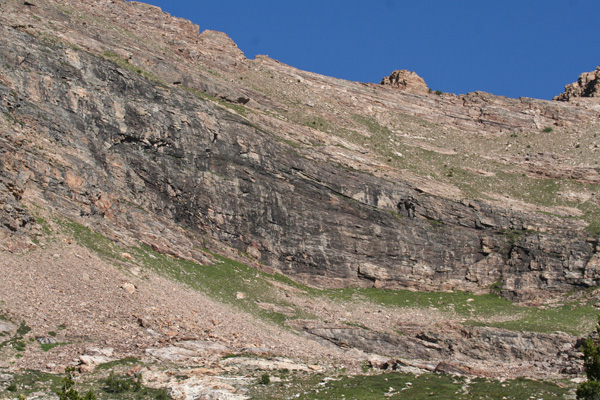
We began the painstaking process of scanning my telescope across the upper reaches of the cirque from whence we believed the calls were concentrated.  Soon, to my great excitement,  a Snowcock came into view in my scope, and both I and my wife were able to observe it very well for several minutes as it slowly pecked its way along the thin and sparse line of vegetation on the steep slope above the blackish part of the vertical wall of the cirque.   My wife, the photographer, was able to see the Snowcock in the scope but she was not able to find it through her camera lens, so we did not get a picture.  We did spot a Mountain Goat, and she was barely able to photograph it.

I was informed that Black Rosy-finches (which would be a life bird) were nesting in the heights above Island Lake, but I was not fortunate enough to find any.  Nor did I spot a Calliope Hummingbird, the other potential life bird that has been seen occasionally in the Canyon.

We enjoyed our banana, cheese and bagel repaste back in the shade at the edge of the lake, birded the area a bit, and then hiked (slowly) back down to the parking area.  We were very happy to have seen our primary target, which can be found nowhere in North America but in the Ruby Mountains.  The Black Rosy-finches and Calliope Hummingbirds will wait for another day in another place. 

A word about the hike:  it is not terribly steep, but if you aren’t in good shape, take it slow.  We are (well, ok, I am) not very physically fit for a trek like this, but we managed to do it twice in two days with no permanent adverse consequences.  The hike to the lake is about 2 miles, and the extension that we took the second day is probably another half mile or so.  At about 10,000 feet, the air is noticeably thin and we needed to pause for breath every now and then on the way up.
An Orange-billed Nightingale Thrush, North America’s Rarest Bird this Week

     This week the bird hot-lines were hotter than usual all over the country.  A South Dakota birder working on the South Dakota Breeding Bird Atlas Survey was parked by a stream running through Spearfish Canyon in South Dakota. As he worked on his survey he heard a bird song that he knew was different from the South Dakota birds whose songs he readily recognized.   He began a search for the reclusive singer, got good views and adequate photos, and ultimately determined that it was an Orange-billed Nightingale Thrush.  He published his finding on the internet, and the Black Hills Bird Rush began. 

     Without the photos, I don’t suppose the birding powers that be would have believed him, notwithstanding his solid birding reputation.  This Thrush is a South and Central American bird which has, to the best of my knowledge, only been identified twice before in North America.  Both of the prior sightings were several years ago, near the Rio Grande.  When he posted his finding, members of the birding community “flocked” to Spearfish from all over the country to try to add this real rarity to their North American Life Lists. 

     When I arrived in mid-afternoon at the well described site, there was no one else there so I sat by the stream, ears tuned, to try to hear the bird.  Shortly after I arrived, Jennifer Fowler pulled into the parking area. Jennifer is a local birder, a South Dakota Bird Atlassing field worker, and a science teacher.  She had undertaken the role of keeping track of the bird and the visiting birders, and helping out all the birders who had and were continuing to come to find it.  Her list of birders was at least 150 names long, including some of the nation’s best recognized, and she was certain that she had missed some.  The list included a good representation of local birders, as well as many from far away places, such as California, Arizona and Florida.   

     Soon after she arrived she cocked her ear toward up-stream, and summoned me to follow her, which I readily did.  We continued to hear, but not see, the bird, as it moved about quickly in the heavy understory of leaves in the trees along the stream.  Several more searchers arrived, and as the evening approached we were all thrilled to get good views of the long-singing Thrush.  ( I suppose the name “Nightingale” may be a clue as to its proclivity to proclaim).  Many thanks to Jennifer.

     The next morning I returned to the site and was rewarded with an excellent scope view of the bird as it sunned itself briefly on an open branch.  I should add that I saw several Orange-billed Nightingale Thrushes in Costa Rica when I was birding there in 2002.  Mission accomplished, however; it is now on my North American Life List as # 682.

Fawn Ornaments


fawns-1

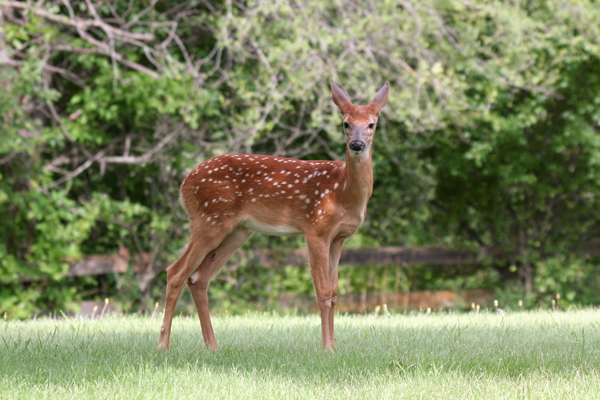
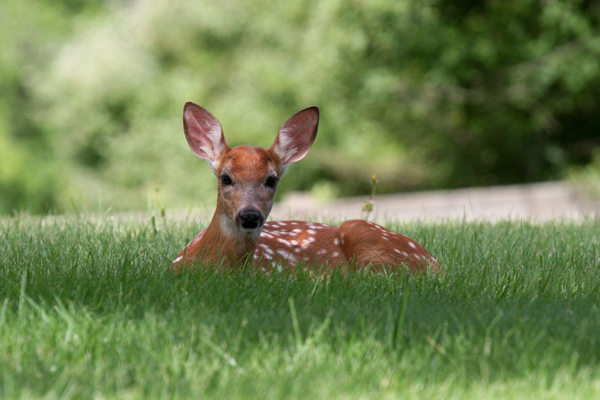
This week, on the hottest afternoon of our summer, we had 2 little fawn ornaments enjoying the shade in our front yard.  When I came home about 4:00 p.m. I was able, without spooking them, to drive past them and get in the house to alert my wife to their presence.  The twins were not a bit camera-shy, so she was able to get some nice pictures. 

fawns-2

fawns-3

And thus we had our own private experience of the Afternoon of the Fawn(s).  If you are interested in some really ethereal poetry, check out Mallarme’s poem bearing that title, (inexplicably misspelling “Fawn”, as “Faun”).  Or, perhaps I misunderstood it.

fawns-4

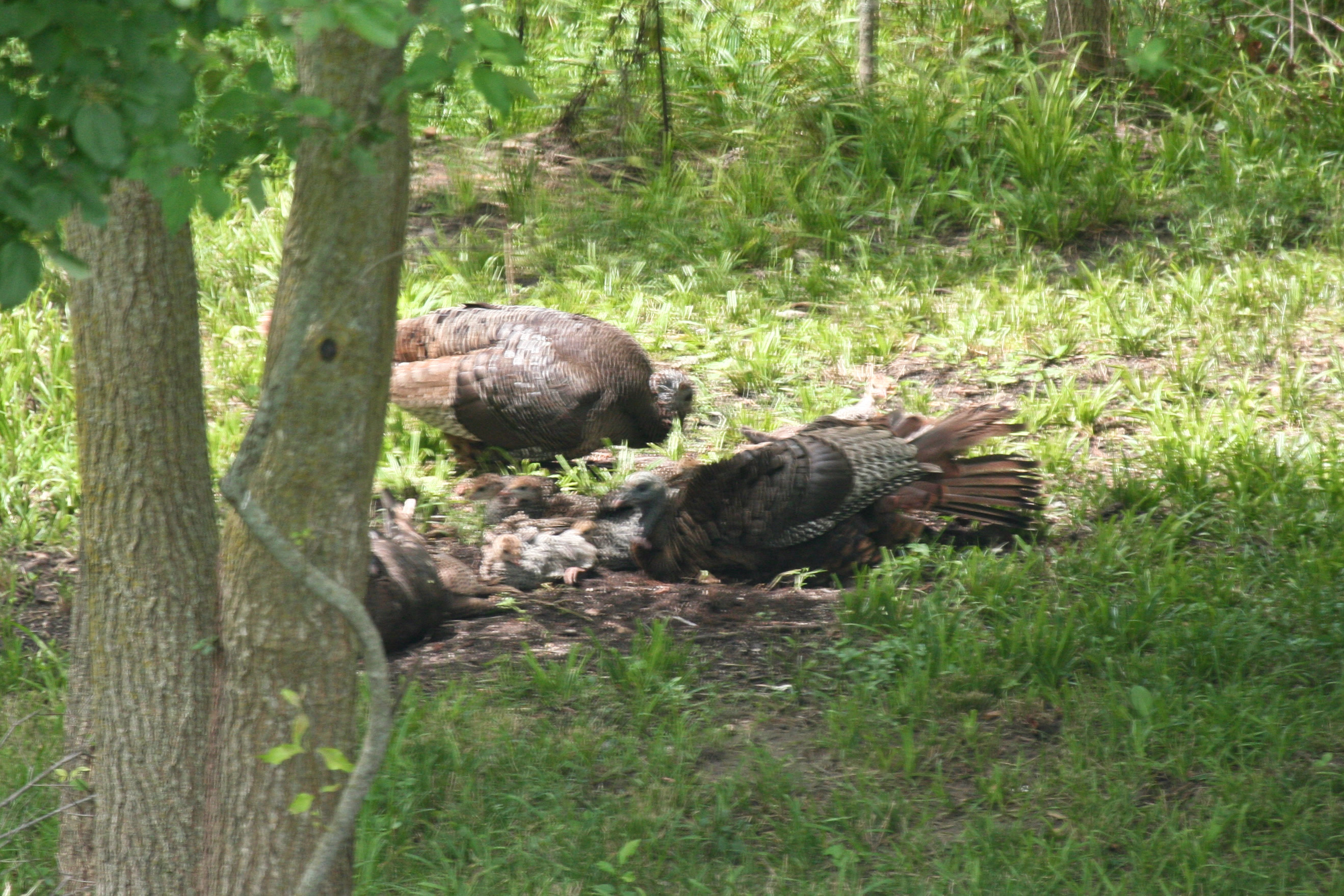
Wild Turkey Poults and Dust Bathing


img_1980-resize

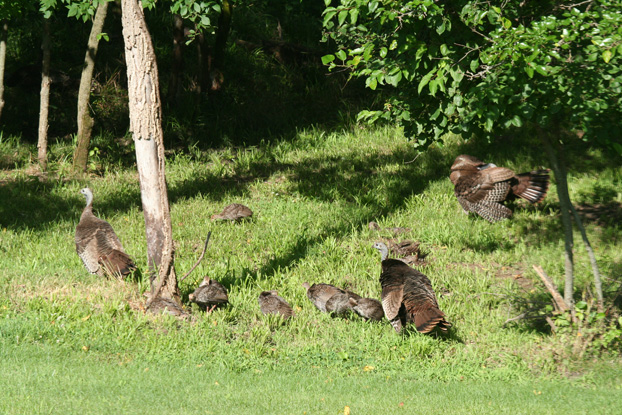
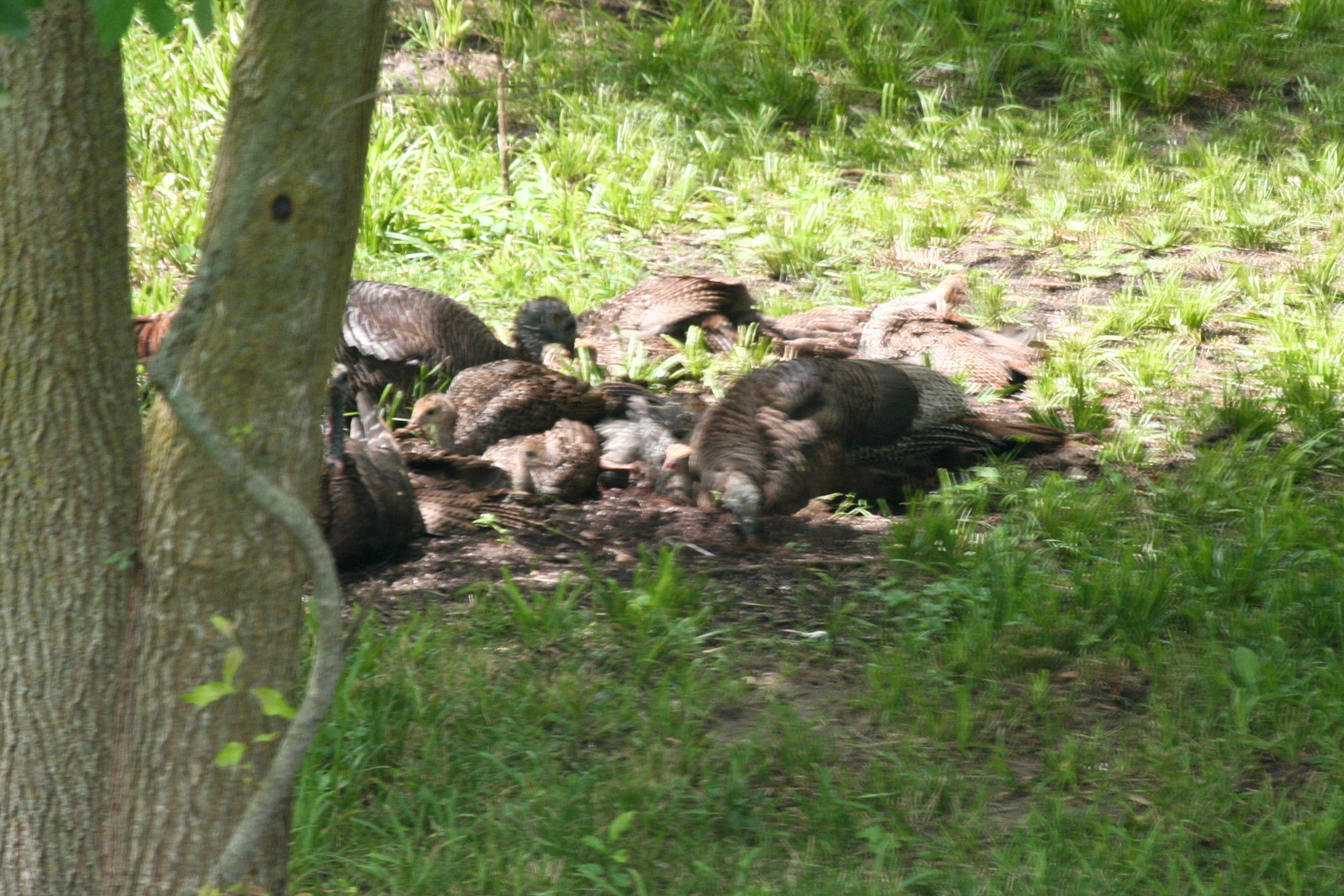
Today the 3 wild turkey hens and 11 poults returned to our yard by Brown’s Woods in West Des Moines, Iowa, and spent an hour or so dust bathing.  I understand the dust bathing ritual may involve efforts to clean the grease from their feathers, eliminate small parasites and/0r cool off.  The little ones seem to learn fast.

img_1988_edited-1

img_1992_edited-1