One day for rare Orioles, Robins and Thrushes in South Texas

I arrived at Bentsen (Texas) State Park in the lower Rio Grande Valley a little after 7:30 a.m on Thursday, January 6th.  The NARBA (North American Rare Bird Alert) had reported that a Black-vented Oriole was being seen in the Park and in the adjoining Bentsen Palm Village RV Park.  The best chances appeared to be in the RV Park.  As I walked to the RV Park I was met by some smiling birders.  The “bird”, they reported, was seen in the RV Park at 7:20, but had flown away.  “No worries”, said one of the ladies; “He will be back”.  So I moved on until I spotted the familiar cluster of tripod-mounted telescopes and binocular laden humans, all pointing at a red-flowering tree beside one of the driveways in the RV Park.  The relaxed attitudes and lack of focus in the group told me that the bird was not there at the moment.  Within 10 minutes, however, he (or she?) reappeared, feeding on the red-flowers of the Coral Bean Tree, obligingly growing and flowering right across the street from where we visitors to the  RV Park were graciously allowed to congregate on this private property. 

To see the Black-vented Oriole so quickly (and so well) was a major surprise and a terrific way to start my day of birding in South Texas.  Just a few weeks ago I was fortunate to find a pair of Streak-backed Orioles near Yuma, Arizona, constituting the 9th of the 10 Oriole species that have ever been seen (documented) in North America.  The Streak-backed Oriole is a Category 4 bird in the American Birding Association Checklist of North American birds.  Category 4 is defined as:  “Casual-Species not recorded annually in [North America] but with 6 or more total sightings of which at least 3 must have been within the past 30 years.”  The Black-vented Oriole is a Category 5, the rarest of all, defined as: “Accidental-Species recorded 5 or fewer times in North America, or fewer than 3 in the past 30 years.”  So, the Black-vented Oriole, became Bird Number 696 on my life list of North American bird identifications.  Not only that, but it completed my list of members of the Blackbird (Icteridae) family in North America. 
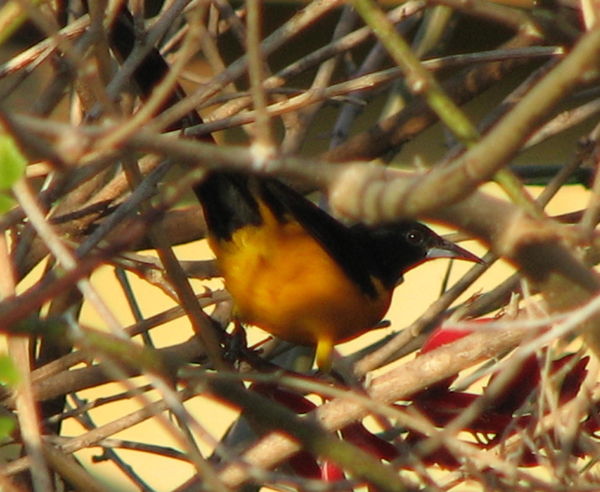
black-vented-oriole

By 8:30 a.m I was driving east on Highway 83 to make a repeat visit to the landscaping business/residence of Allen Williams, on the east side of McAllen.  I arrived about 9:00 and joined a group of 3 college students from New Hampshire who were using their college break for a one-week birding tour of Texas.  It was not long before one of them spotted the bird of interest, a Crimson-collared Grosbeak.  She (referring to the bird) (clearly “she”, because of the absence of any hint of crimson in the feathers of this dimorphous species) is  dull green with a distinct black hood.  Allen Williams has restored the area around his home to pre-settlement vegetative state, enhanced by water features.  It is an oasis in an urban setting for rare and unusual birds who find themselves out of their normal territory.  He welcomes birders, with prearrangement by phone and a small contribution to maintenance of the area.  This year, the female Crimson-collared Grosbeak has been on-site since mid-November and many birders have had the pleasure of seeing it, although on some days, it does not make itself known.  Thanks, Allen.  This ABA Category 4 bird became number 697 on my life list.  This trip was already exceeding all my expectations. 

At 9:30 I was on the road again, this time heading east and south to Estero Llano Grande State Park, south of Weslaco.  On December 29th there was a report that a White-throated Thrush (until recently called a White-throated Robin) was seen there.  It had been seen subsequently on several occasions when it came to drink at a water feature in the Park.  This ABA Category 5 bird was obviously of great interest to the birding community, as there were at least 15 birders standing near or sitting on conveniently located benches a short distance away from the water feature.  I sat.  And sat.  And sat.  No bird.  Maybe my luck was ending.  A young man sat next to me whom I recognized as having been in the group looking at the Black-vented Oriole a couple of hours earlier.  We visited to pass the time of day.  At 2:30, an older gentleman wearing “Park Volunteer” identification came by to tell me (I and a recently arrived photographer, originally from Johnston, Iowa, were the only ones still sitting and waiting) that he had just seen the bird in some thick undergrowth at the edge of the Park.  We quickly walked the short distance.  We were quickly joined by 15 or more other eager seekers, including the New Hampshire college students and Chris, the young man who had been with me at the water feature and oriole site earlier.  Chris spotted the bird and got some pictures.  I did not at first see it, but later I was able to get a terrific look as it sat still on an open branch.  Hurrah!!!  Life bird number 698, and the day was not over.  Maybe I could go look for my often sought and never seen Rufous-backed Robin. 

White-throated Thrush
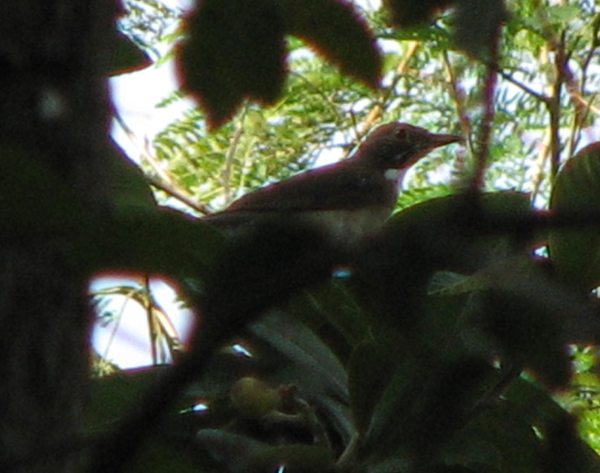
white-throated-thrush

By 3:00 p.m. I was back on Highway 83 heading east through Rio Hondo to the Laguna Atascosa National Wildlife Reserve.  A Rufous-backed Robin was being reported there intermittently from the third week of November.  I had gone to try to find it on two different days a month or so earlier, with no success.  But this day was my lucky day.  About 5:00 p.m. the Rufous-backed Robin appeared at the water feature where about a dozen or so eager birders were silently hoping for that event.  Silent cheering on the part of all.  As luck would have it, Chris, mentioned earlier, was also there.  I asked if he would send me some of the photos he had taken of the Oriole, the Thrush and the Robin, and he promised to do so.  And he did so promptly.  The pictures accompanying this blog were provided through the courtesy of Chris Warren of San Marcos, Texas.  He is a fine birder and even if he doesn’t have 30 pounds of equipment, he managed some pretty good shots of these rare North American visitors.  Thanks, Chris. 

Rufous-backed Robin
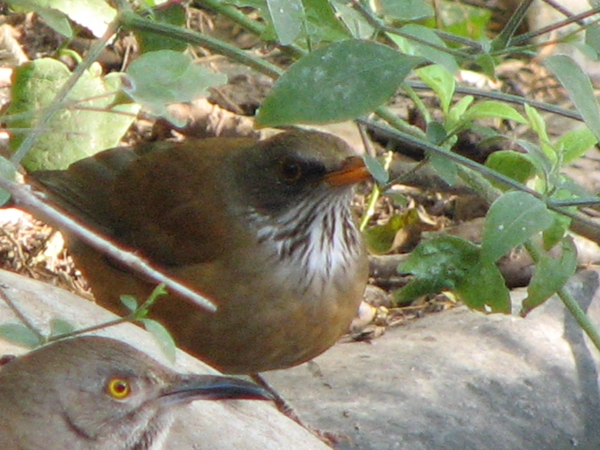
rufous-backed-robin

So, what is the (all important) count?  Right:  699.  I knew immediately at that point that I was not going to look at a bird on the way back to McAllen to catch an early flight home.  If I racked up number 700 in the absence of my photographic assistant and travelling companion, Barbara, I absolutely would be persona non grata at home.  Ah, me!!!  From the glories of 70 degree days, sunny skies and soft breezes in south Texas, to a whipping snow storm, freezing temps and dark skies in Iowa.  Yet, life is sweet.  Oh, and did I mention:  the Rufous-backed Robin is just a Category 3 bird, meaning, “Rare-Species occurs annually in very low numbers.”   This was very likely the most fruitful day of birding I will ever have in North America, if you grade it by the combined numbers (4) of new life birds multiplied by their difficulty of finding (5, 4, 4, and 3).  If my math is correct, it was a Category 64 day.  Of course, I don’t know of anyone else who grades success that way.  I just thought it up.  Yikes!!!  Have I always been so obsessed with high grades???

Birding is, to use the cliche, interesting.  During this past year or so I have climbed for miles up tall mountains (e.g., to find my Himalayan Snowcocks in the Rubys); I have struggled across spongy, lumpy, Grizzly Bear infected tundra (e.g., to find Bristle-thighed Curlews near Nome); I have enjoyed the Boston Symphony preparatory to looking for the Barnacle Goose on a roadside pasture in nearby Concord, from the comfort of my car; I have walked through rain and mist in freezing temperatures by Hudson’s Bay in New Brunswick (to see a Pink-footed Goose); I have endured a night in third-tier bunk on a wave tossed boat in the Pacific in a two-day (fruitless) search for Pelagic species; and a wild and bumpy day-long ride on a fast boat in the Atlantic scouting for Atlantic Pelagic species; and other, diverse searches, including, of course the most successful and least strenuous of all:  sitting and waiting for “The Bird” to show up at a favorite destination, such as a water feature at Llano Grande State Park or at Laguna Atascosa National Wildlife Preserve, in Texas.   While waiting for the specific, much of the general can be seen.  Of most recent memory are the lovely Mexican Blue Butterflies that Chris identified and that filled the air around me while I was sitting in the shade on a warm, sunny winter afternoon in South Texas.
Streak-backed Orioles in Arizona

“I’ve got an ocean front property in Arizona; from the front porch you can see the sea!”  So goes the song.  This week my version is: “I  found some Streak-backed Orioles in Arizona; from the front road you can see their tree.” 

Actually I went to Phoenix primarily hoping to find the Baikal Teal that had been seen at the Gilbert Riparian Park for a week or so.  Never before had this northern Asian species been seen in Arizona, and very infrequently has it been seen in the United States.  There is some question whether this one is really is a wild bird or whether it has escaped from an exotic bird farm of some sort.  Unfortunately, the Baikal Teal has not been seen for several days, beginning the day before the day I was there.  The day I spent at the Riparian Park looking for the Baikal Teal was the hottest on record for that date in the Phoenix area.  From 10 above on the Fahrenheit scale in Iowa to 90 above within 6 hours was a bit of a challenge.  The Riparian Park itself, however, is a lovely spot with lots of birds of many species, so the day was not wasted. 

My second day in Arizona was to be devoted to finding  Streak-backed Orioles.  Reports had been fairly regular and encouraging that two of these Mexican species had adopted as their winter residence a farm grove at the edge of an agricultural area between Weldon and Tacna, just east of Yuma, AZ.  I arrived there early on the road adjacent to the farmhouse and grove.  No one else was there.  The temperature was closer to what I left in Iowa than to what I had encountered the day before in Phoenix.  I walked up and down the road several times and about 9:00 a.m. I spotted 2 orioles at the top of a Pomegranate Tree.  They were being very cooperative, foraging at the top of the tree not hidden by foliage.  I was virtually certain they were the Streak-backed species, but I could not make out the streaks on their backs with my binoculars.  Fortuitously, a young man arrived about that time, binoculars in hand.  We soon connected and confirmed that we were seeking the same bird.  I showed him the spot where I had seen the Orioles, and we both were able to observe them for several minutes.  I lamented that I would really like a telescopic view to be completely satisfied as to their identity, but that I had not brought a scope with me in order to travel more lightly.  He replied that that would be no problem.  He went to his car and came back with a telescope and we were both able to scope the birds well for several minutes, with clear identification of the distinctive marks of Streak-backed Orioles.  Very satisfying.      Thus, Streak-backed Oriole became my 695th North American species.  It is a beautiful bird, to boot.  This completes my sweep of all 9 of the Oriole species listed in Sibley’s Field Guide.  National Geographic lists a 10th, the Black-vented Oriole, which is even rarer.  Interestingly, someone has just reported seeing a Black-vented Oriole in southern Florida.  But with the holidays at hand, that trip will have to be deferred.  Moreover, I think only one person has reported finding it and I would not make the trip based on that skimpy record. 

After we had both had our fill of viewing the Orioles, Alex asked if I had seen the Bean Goose that has been hanging out at the Salton Sea in California.  I said I had not, but that I had seen one of that species on Adak when I was there a few years ago.  He said he was going to drive over to try to find it as it would be a new Life Bird for him.  I decided to join him and we “convoyed” over to the Salton Sea.  We encountered thousands and thousands of beautiful white Snow Geese at the Salton Sea, but the Bean Goose had chosen that day to hang out somewhere else, so I left without finding it.  Alex, a grad student at the University of Arizona, however, stayed on to make full use of his day without classes. 

My final target bird for this Arizona trip was the Rufous-backed Robin.  Yes, the very same elusive species that I had sought fruitlessly in Texas a week or so ago.  This required a trip back to Arizona and half way across the southern part, to a spot not far north of Nogales called Santa Gertrudis Lane.  This is a fascinating little area providing access to the banks of the Santa Crus River.  It was dedicated to public use by the original owner of the ranch that has now been carved into many smaller pieces, but all the owners are obligated to abide by the public use requirement of the Lane that they also must use to reach their properties.  Once again, this secretive Robin avoided my detection.  Early in the morning when I was the only birder on the Lane, a car stopped and the driver started a conversation with something like, “I don’t quite know how to tell you this but I guess the best way is to just tell it like it is.  Last night a couple of miles down the road a Border Patrol Agent was murdered by members of a Mexican Drug Gang.  Some of them were caught, but one or two have escaped and are at large in this area.  I suggest that you stick to the main roads today for your own safety.  This road is safe, but I would not go back into the bush along the river.”  We proceeded to visit for a while and when he found out I was a lawyer he had a good laugh and a couple of lawyer jokes to tell me, which I appreciated!!!  He is a retired aviator who bought a 200 acre ranch at the end of the Lane and I learned a lot about the problems of having so many people living down that road.  Later in the day, he came by again and invited me to come see his place, so I got in his vehicle, we forded the river, and drove around his ranch for an hour or so.  I didn’t see many birds but I really enjoyed seeing the ranch (he boards horses for others for $215 per month, and has up to 90 horses on board during the winter months).  He provided me with a supply of bottled water and drove me back across the river so I would not get my feet wet.  I spent the rest of the day looking for the Robin, with no success.  I do want to express my thanks to the good Samaritan, George, who gave me good advice and a friendly reception.

Irony of ironies, when I checked my Rare Bird Report Site this morning, there was a report by my birding  neighbors here in West Des Moines, Reid and Pam Allen, that they saw the Rufous-backed Robin yesterday at the very same location in Texas where I spent a day and a half two weeks ago, looking for it.  Oh, well, maybe some day I will find that darn bird.

Rare birds in Texas

Monday I went to McAllen, TX to search for the Rufous-backed Robins that were being seen at the National Butterfly Center in Mission and at the Laguna Atascosa NWR on the coast.  I drove to the Laguna Atascosa Visitor Center, arriving about 2:00 p.m.  With a couple of others, I kept watch for the rest of the afternoon on the little brook at which this skulky Robin had been seen on several prior occasions.  I believe I saw it but the lighting conditions were not the best, and since none of the other observers saw it,  I would have to say that it was a possible sighting, and not one that I could be sure of. 

Plan B was to go to the National Butterfly Center the next morning, Tuesday.  Morning sightings of a Rufous-backed Robin had been fairly reliable there of late.  However, by 5:00 p.m. I was weary and the gates were about to be locked so I left, with no bird seen.  The day was lovely and there were plenty of nice birds to be seen as I sat (or stood)  by the water feature.  Prominent among them were the colorful Green Jays and Great Kiskadees.  About 20 other less colorful species  came by during the course of the day.   These included several that are not found in Iowa, such as  Plain Chachalacas, Black-crested Tufted Titmice, and Long-billed Thrashers, (which I first mistakenly identified as Brown Thrashers, until corrected by one of the local bird/butterfly enthusiasts).  Most of the others seen there are commonly also seen in Iowa.  Several local butterfly experts stopped to visit and offer encouragement.  These were  mostly former birders who have, as they freely admitted,  gone over to the “Dark Side” (Butterflying).  In fact, as the day turned warm and sunny, the butterflies were numerous and pretty and added a welcome diversion from  the long and fruitless search for the Rufous-backed. 

With one more partial day to go, I decided to return to Laguna Atascosa.  While I was there on Monday, the staff at the center told me that they have had a number of sightings of Aplomado Falcons on the preserve in recent years, including recent days.  I have never seen one of these lovely raptors in North America.  If the Rufous-backed Robin was going to elude me, at least I might come back with one new North American Life Bird to add to my list and, indeed, I did.  In fact 2 of them.  As I was nearing the Preserve at about 8:00 a.m., one was perched on a utility wire along the road and held still for a very nice view.  Then, as I entered the Preserve, a second one put on an aerial show that was amazing, including the capture of some sort of small creature in a grassy field along the road.  The Aplomado Falcon, primarily a Central and South American resident, was once somewhat common in south Texas, but was extirpated from the area for a large part of the 20th century.  A reintroduction program at Laguna Atascosa has been quite successful and in the past two or three years, more of them are being seen on and around the Preserve.  The winds became very strong and birding was extremely difficult, so I decided not spend any more time at the Preserve.

My final search of the day was at the Allen Williams’ residence and landscaping operation in Pharr, TX.  Allen has had a female Crimson-collared Grosbeak, another Mexican visitor, on his property for several days and this would be a new life-bird for me.  Unfortunately, high winds and bad timing joined me on this visit, which I had to cut short to make it to my plane on time.  Thanks to Mrs. Williams and her mother, I was able to enjoy a tasty hot flavored tea drink during  my brief search about their property.  Their gracious hospitality was very much appreciated.

Ross’s and Little Gulls in South Dakota

Shortly before Thanksgiving day the North American Rare Bird Alert posted the finding of a Ross’s Gull at the Gavin Point Dam area on the Missouri River near Yankton, SD.  This was the first ever reported sighting in Nebraska and the second ever in South Dakota.  The Iowa Bird Line picked it up and sent out an alert to its subscribers suggesting that a trip across the border might be in order to see this rare “lower 48” visitor.  Shortly before noon on Saturday I drove to Yankton, arriving around 3:30.  I searched for the Ross’s among the flurry of Bonapartes and Ringbilled Gulls air-fishing in the tailrace below the dam.  No luck.  I drove across the dam and turned right, toward a complex of frozen ponds.  There several birders had their scopes lined up looking at the Ross’s Gull, which was sitting on the ice in the midst of a flock of Ringbills and Bonapartes.  I am learning that one of the best strategies for finding rare birds is to first look for the rare bird searchers. 

The Gull was very cooperative as it sat and walked on the ice for nearly an hour.  It then flew off into the sunset so I was unable to get a good view of it in flight.  However, the sitting and walking views were satisfactory.  The bird was clearly pink on the breast and belly.  The black ring band on the back of the neck was not present, as is to be expected in a winter bird.  It looked a lot like a little seal with its round, white face with large black eyes and black bill as it sat on the ice looking directly at us.  The eyes seemed unusually large for a gull.  I was happy to add this bird to my Life List as number 692.  I have considered travelling to the Churchill area in northern Manitoba to view the Ross’s Gulls that have been seen there in recent years, (although in very limited numbers now) but it was much more convenient  to drive to Yankton from Des Moines. 

While chatting with the other birders who were looking at the Ross’s, one of them mentioned that a Little Gull had been seen at the Oahe Dam north of Pierre, SD.  I decided to extend my visit to SD and stayed overnight at Yankton.  I left for Pierre about 4:00 a.m. the next morning.  I arrived about 8:00 and after a quick breakfast, began my search for the Little Gull.  At first, the only gulls visible were too far out on the reservoir to identify.  I looked down-river and around the dam, with no luck.  About 10:30, the gulls started moving and I was able to locate the Little Gull on an ice-covered pond very near the power plant,  just below the dam.  It was nestled on the near side of a large flock of resting Ringbilled Gulls, Bonapartes Gulls, one Black-legged Kittiwake and one Glaucous Gull.  The little Gull was very close to the West Tailrace track,  so the view was excellent.  It was easily distinguished from the sometimes confusing Bonapartes because of its much smaller size.  It was a first-winter gull, with a lot of black on the wings.   This became my North American Life Bird number 693.  I have previously searched for Little Gulls reported once in Dickinson County, IA and annually by Lake Michigan in Manitowoc, Wisconsin, without success.    The 700 magic number is getting surprisingly close.  I doubt that I will reach it in 2010, but with any luck, 2011 will be the year.  These two gulls were high on my list of “Want to See”, so it felt like an early Christmas present.  I guess I fit right in with the Black Friday/Saturday mad shoppers, only I don’t have to wait in line for the stores to open.

Pink-footed Goose in New Brunswick

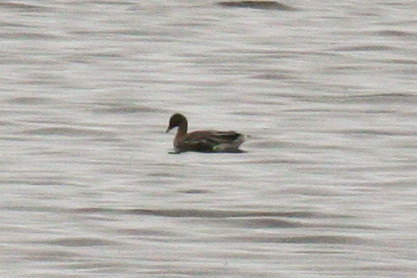
A week or two ago the North American Rare Bird Alert reported that a Pink-footed Goose had been seen in the area east of Moncton, New Brunswick.  This was the first reported sighting of this species in New Brunswick, and very few of this Arctic and northern European species have been found anywhere in North America.  With plenty of time on our hands, we decided to go there to try to find it, so last week we made the trip.  The weather in New Brunswick had been terrible for several days with lots of rain and fog, so our flights were often delayed.  Ultimately we arrived in Moncton in heavy fog.  The next morning was gloomy, but the rain was temporarily gone.  We drove out to the little community of Corvierville.  Within an hour or so we spotted the Pink-footed Goose on the water, not close, but easily viewed through my scope. 

Pink-footed Goose

pink-footed-goose_edited-1

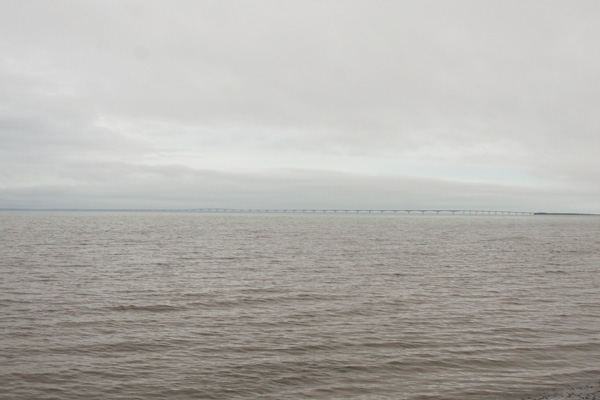
Having seen the goose relatively quickly, we decided to drive to Prince Edward Island.  We crossed the Confederation Bridge to the Island and drove to Charlottetown, the capital of the province.  The Bridge is the longest bridge in the world across ice-covered water, and the 7th longest  bridge in the world.  A toll of $43.50 is payable when you cross back over the Bridge to New Brunswick. 

bridge

Prince Edward Island is a very pretty area, with agriculture surrounding the capital city.  We enjoyed a pleasant evening out at a very nice restaurant in down-town Charlottetown. 

The next morning the rain was quite heavy.  We drove back across the bridge and down to Nova Scotia.  There we drove to the Bay of Fundy for a view of this area of great tides. 

bay-of-fundy

Then, after many more delays,  we flew to Montreal, and, the next morning, to Des Moines.

A Rare North American Barnacle Goose

A national rare-bird hotline has been reporting a number of sightings of Barnacle Geese in various parts of northern New England.  This seems to be a big year there for Barnacle Geese, which are seldom seen in North America.  Barbara and I flew to Boston last week to seek and photograph one.  But first, we took advantage of our proximity to Boston’s Symphony Hall to hear the Boston Symphony’s Saturday night performance of compositions by Bach, Adams, Prokofiev and Bartok.  Symphony Hall was constructed more than 100 years ago in central Boston.  It  still claims a ranking as the best acoustical venue for orchestral and symphonic music in the United States, and third in the world.  The sounds we heard justify the claim.  But just as impressive as the Boston Symphony and the music it produces, is the building itself.  If any of you ever get a chance to spend time in Boston you should see Symphony Hall, even if there is no performance in process.  The building and its interior are worth a visit.  If there happens to be a performance and Bartok is on the program that day you might want to skip that, however. 

We stayed in Concord the first night and took the “T” back into downtown Boston for the performance.  As it was Halloween, the train was filled with costumed revelers, probably from the various colleges and universities which line the route.  For $2, you can’t beat the ride and the convenience.  The party atmosphere added to the ambiance. 

The next morning we drove a very short distance from Concord in search of the Barnacle Goose being seen at the Prison Fields near Concord.  It was not long until Barbara spotted one among a large flock of Canada Geese (my North American Life Bird # 690). 

barnacle-goose

So now we could come home, right?  Not so fast.  In addition to the Goose, there had been some reports of another rarity being seen on Plum Island, an hour or so drive north of Concord.  After viewing and photographing the Barnacle Goose, we drove to Plum Island.  It was a beautiful drive.  The fall colors  north of Boston are far more vivid than they are here in Iowa and there was a surprising amount of foliage remaining in the trees. 

Plum Island is a barrier island but with considerably more vegetation than we have been accustomed to during our many sojourns on Padre Island.  The north wind became very fierce, driving fine sand as we spent several hours tromping around the beach and wetlands in search of  our second rarity, a Curlew Sandpiper. 

plum-island

We gave up (wore out) and headed back up the island for a late lunch at a small, local diner.  Our efforts to find the Curlew Sandpiper continued the next day, with somewhat more tolerable weather, but again without success.  This Herring gull flew by with a closed clam which it dropped on a rock.  The shell broke, and the gull consumed the contents.  

herring-gull

We then drove to Gloucester in search of another possible lifer mentioned by a helpful birder we met at Plum Island.  This bird, the Purple Sandpiper, although not rare in the east in winter, has eluded me for years.  It still eluded me, but the afternoon spent on the rocks at Haddock State Park near Gloucester, overlooking the Atlantic Ocean, was most enjoyable. 

gloucester

We were treated to a close-up view of 3 first-of-winter Snow Buntings, lazing about on the rocks, but they flew away before Barbara could get a picture.  

Gloucester was first settled in the early 1600s.  It is the oldest seaport in the United States.  It has a somewhat down-at-heel appearance these days.

Late October Sparrows in Iowa

I participated in the Iowa Ornithologists’ Union field trips this past weekend.  These were run in connnection with the fall meeting of the IOU at Neal Smith Prairie Preserve near Prairie City.  On both days I elected to participate in the field trip which  “walked” the prairie in search of Smith’s Longspurs, Lapland Longspurs and the various sparrows (e.g., the Emerizinae Subfamily) that can be expected in central Iowa in late October.  No Smith’s Longspurs were seen, probably because they have not gotten this far south yet.  A few Lapland Longspurs were observed in flight.  The sparrows were a better story. 

 The best observations were of LeConte’s Sparrows.  We saw several each day and they made themselves very obvious by coming within a few feet of the group and posing close-by on whatever little stalks or twigs that they could find.  The photographers in the group were especially ecstatic.  Everyone remarked that never before had they observed so many LeContes at such close and sustained range.  Clearly, they were the highlight for many of the birders, including me. 

The other sparrows that I was able to identify were:  White-throated, White-crowned, Savannah, Vesper, Swamp, Song, Fox, Lincoln’s, Harris’s,  Field and Juncos.  Some other particpants reported finding a Clay-colored, one or two early Tree Sparrows, and a late Grasshopper Sparrow.  Oddly, I do not recall if anyone saw any Chipping Sparrows, and I would have thought they would still be present.   Another less surprisingly absent (I believe) species was Nelson’s.  Henslow’s, which are now quite common at Neal Smith in summer, were all gone.  Nor, as I recall, did anyone see a Lark Sparrow. 

It looks like a good year in Iowa for the northern finches.  A fair number of Pine Siskins and a few Purple Finches were observed.

Birding Central Iowa in October

The first and second southward migration waves have passed through central Iowa.  We are now on the last phase.  Now present in big numbers are Yellow-rumped Warblers, and sparrows of various sorts.  I was standing quietly in my back yard woods this morning when a Woodcock flushed about 30 feet from me, flew across the ravine and fluttered to a landing about 60 feet away, in plain view.  It was a nice way to end an otherwise  uneventful morning of birding my yard and surrounds.  Juncos, White-throated Sparrows, one Orange-crowned warbler, and one Brown Creeper rounded out the morning.  Of course, many of the usual customers were around, but I will not bother to list them. 

Yesterday I drove to Rock Creek Park, about 45 miles from here, to try to locate the Red Phalarope reported on the Iowa Bird Line.  It was easy.  The Phalarope was very cooperative and in plain view all the time I was there.  This was my new Iowa Life Bird for the fall:  number 321, lifetime Iowa.  I must confess that I prefer to see Red Phalaropes in breeding plumage, when their name is deserved.  The “fall” or “basic” plumage of gray and white gives no clue that this is really a Red Phalarope.  But, I’ll take it given that I have never seen one in Iowa in breeding plumage.  Several other species were feeding on the mud flats north of F27 at Rock Creek, i.e.:  30 Kildeer, 15 Snipes, 12 American Pipits, one Greater Yellowlegs, one Pectoral Sandpiper and one Semi-palmated Sandpiper.  Most of these were first of the year for me.  The weather and the lighting were wonderful, so the trip was an unmitigated success.

India Trip – Part 5

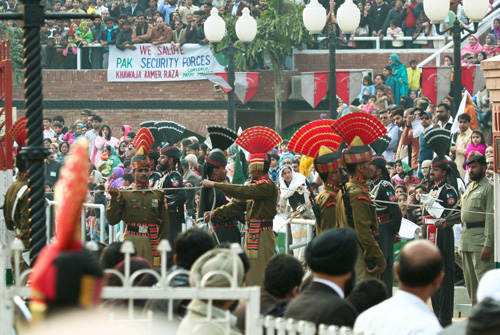
Friday, February 5  Ready to go to the airport at 6:00. Flight was late, but we had extra time in Delhi before going on to Amritsar. We arrived in Amritsar about 30 minutes late and there was no one there to meet us. Another guide called our hotel for us and we were told the car would be there in 10 minutes. When they arrived, the young woman said she was late due to traffic, but the lady at the hotel said they were late because the flight is always late and they didn’t think we would be there so soon. This was our first and only hitch with AK. It was getting late in the afternoon, and they did not want to take us anywhere because no guide was available. After a bit of discussion, they arranged for our driver, Sam, to take us to the Wagah Border with Pakistan to see the daily evening closing ceremony. [Normally drivers are not given that much responsibility without a guide present]. It was such an event! There was big cheering on both the India and Pakistan sides. “Long live Hindustan” and “Long live Pakistan” rang out from the crowds in support of their respective countries. It was very ceremonial and quite pointless, with soldiers in fancy dress strutting up and down the road to the border crossing to embellish the closing of the gate for the night.

Changing of the Guard at the Wagah Border between India and Pakistan

border

It reminded us of the Ministry of Silly Walks. We were very glad that we had insisted on coming here tonight. Back for dinner at our hotel. The food was not very good, but we enjoyed the company of a couple from Switzerland, the only other guests at the hotel that night. At 9:00 p.m., our guide, who had been previously occupied during the day, showed up to take us to the night ceremony at the Golden Temple of the Sikhs. What a gorgeous sight, especially at night.

golden-temple

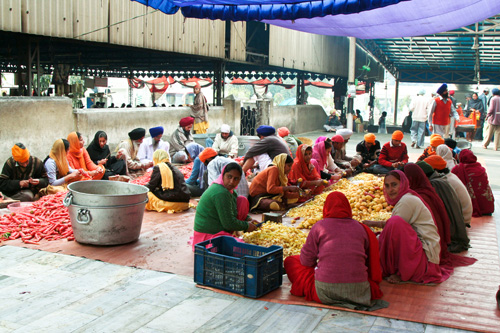
Saturday, February 6  Back in the morning with our Amritsar guide to see the Golden Temple by daylight. It is our first cloudy day, but still nice. We entered the Temple area after leaving our shoes and socks and washing our feet in the shallow foot bath in front of the entrance to the Temple area. This is the holiest of Sikh shrines. It was amazing to see the 24-hour kitchen which feeds 30,000 people, for free, every day. All work is done by volunteers.

volunteers

We went into the Temple to see a priest reading from the huge, Sacred Book. Many Sikhs were in prayer. The Temple is even more beautiful inside than out, but no photos are allowed. We finished our tour of the area by seeing the “bed” where the smaller holy book stays throughout the day. We walked through some old city streets to see the memorial park where the British fired 1600 rounds at a gathered crowd 100 years or so ago, killing and wounding many, and abandoning them where they lay. Back to check out from our hotel and on to the airport. This was our least favorite hotel. It is a very old eclectic place featuring aromatherapy, and not much else, for the guests. It is probably cleaner than it seems but just not our style. We were dropped off at the airport. Another glitch: our tickets were not changed to show we were leaving Amritsar for Delhi today instead of tomorrow. Fortunately, the airline representative was able to finally change our tickets, and we were on our way. We were met at the Delhi Airport by our AK representative and taken to the Delhi Oberoi Hotel. We drove though Embassy Row on our way. Lots of parks and green space. This is a very nice hotel and a welcoming complimentary bottle of wine awaited us, (Delhi is a bit more cosmopolitan than the other places we have been). We enjoyed a very nice Italian dinner at the Italian restaurant in the Hotel: gnocchi with walnuts and raddicio, chocolate lava cake for dessert.

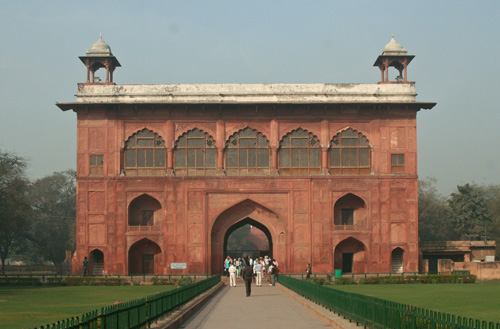
Sunday, February 7  We started early. Our guide, Jaibir, took us to see both old and new Delhi on a whirlwind tour. We started in Old Delhi by seeing the Red Fort built by Shah Jahan. It is a large area of mostly red sandstone.

red-fort-delhi

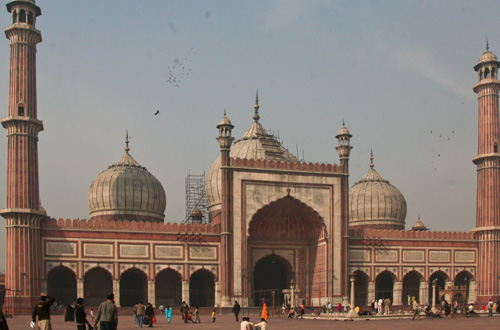
Then to Jama Masjid which is still the largest mosque in Asia. All women get a large cover to wear.

mosque

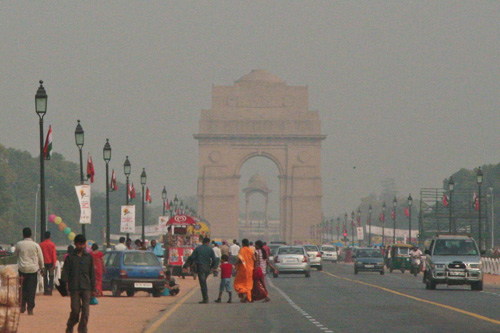
We took a very fun ride in a rickshaw through the narrow streets of Old Delhi.  On we go to the park where Mahatma Gandhi’s ashes are buried. Next stop is Humayun’s Tomb, which was built by Humayan’s wife in his honor. Red Sandstone and white marble. Lots and lots of school boys are there for a cultural field day. We take a drive by the big, beautiful area of the President’s house and other very large government buildings leading to India Gate, built to commemorate those Indian soldiers who died in World War I.

india-gate

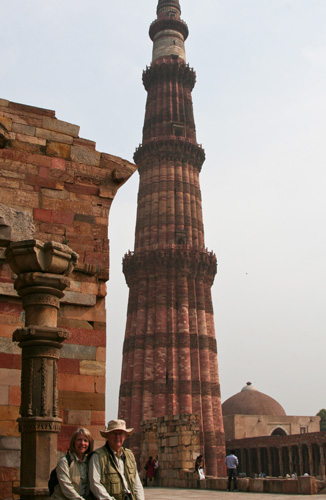
The last stop is in South Delhi to see the Qutb Complex, begun in 1193. The minar is 250 feet high with intricate carvings. Buildings around it have carvings similar to those at Khajaraho. The iron pillar in the court yard is from the 4th century.

qatb

Last stop is Lakshmi Narayan Mandir, a newer, yet ornate Hindu Temple. Even a nice shop next door to where we left our shoes. Back to the hotel for Barbara to pack up and rest. We had a light supper after such a big lunch. Nasheef, the AK representative, was very helpful at the airport. There was a very long line at the passport check, but all went fine, with plenty of time.

Monday, February 8  The flight actually left Delhi this morning at 2:00 a.m. All went well. There was plenty of time in Amsterdam, then on to Detroit. Many hours of sitting. Since Barbara had not checked luggage, she got through passport check and customs and security very quickly. She arrived home safely to be greeted at the airport by Melanie. Upon arriving home she enjoyed a big glass of water from the tap.

I stayed on in Delhi to meet the birding group with which I would spend the next 3 weeks in India.  I will be posting the results of that trip, with far more emphasis on the birds and with far less detail, than has gone into the preceding report.

India Trip Report – Part 4

Several weeks have passed since I posted the third installment of our report of our trip to India earlier this year .  Here is the fourth installment. 

Friday, January 29   One last look at the Taj Mahal from our balcony at the Oberoi. Then off by road and driver, Badel, to the deserted fortress at Fatehpur City, “City of Victory”. Built of red sandstone by Mughal Emperor Akbar for his three wives (one Muslim, one Hindu, and one Christian) and (far more numerous) harem, the biggest space by far was for the Hindu wife who finally bore him a son. We stopped in Bahratpur for lunch on the veranda of a hotel, and then went birding along a filthy canal with the AK representative who met us there, knowing I was interested in birds. We enjoyed the train ride of about 4 hours from Bharatpur to our second Tiger Preserve, Ranthambore, south of Bharatpur in the State of Rajesthan. The first-class car in which we rode was very nice, but the other cars were greatly overloaded with passengers. We were instructed to get off at the 5th stop, a village near Ranthambore, but it wasn’t clear how many of what we experienced along the way were “stops”. The porter, however, took very good care of us and two  other American couples traveling on their own to the same destination. Late evening we arrive at the Oberoi Vanyavilas just outside Ranthambore. Oh my!! Such a fabulous place. Who could ever think that 3 nights in a “tent” could be so luxurious. It is like having our own house, with a few upgrades. (We later read in some travel literature that this hotel was rated number 2 in the world by Travel and Leisure Magazine). Dinner was served in an outdoor courtyard with a big fire pit in the middle. Tonight is full moon, clearly seen above the courtyard, together with Orion. It is like being in a fantasy world. 

tent

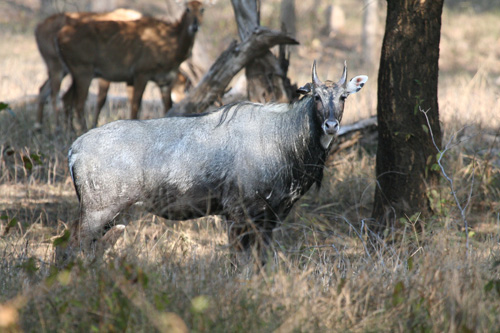
Saturday, January 30   Tea and cookies are served in the lobby to tide us over the early morning game drive into the park. We start out at 6:15 with our Ranthambore guide, Najeef. He is a friend of Jagat, who was our guide at Bandhavgarh, and he is exuberantly proclaiming that he is a much better guide than Jagat. The morning drive does not produce a tiger, but many birds, spotted deer, Sambahr and Nilgai.

nilgai

Back for a yummy breakfast of French Toast filled with ham and cheese and topped with maple syrup and whipped cream. Out again in the afternoon, but still no tiger. I did not go on this game drive (the “roads” in the park are rough) because my back and knee were both giving me a lot of pain. I enjoyed a quiet afternoon strolling around the grounds and finding a goodly number of new birds.  We had another lovely dinner in the outdoor courtyard and retired early. 

Sunday, January 31   Dawn arrives with another beautiful day. Tea and cookies were served and then we were off to a different part of the park. We saw a really big, beautiful tiger right up close. He was moving quickly, so Barbara did not get a picture, but it was a scene that we will both always have in our minds. We also saw gazelles, a mongoose, and 2 golden jackals. A good morning!

golden-jackal

Relaxing time after breakfast and a shower. The afternoon game drive was another success with another tiger, this time a sleeping tigress. Such a beautiful animal! Back at the hotel we checked our email while having a “Manhattan”, which we concluded had been made from Scotch and Dry Vermouth, although we were assured the bartender really knew how to make Manhattans. We enjoyed another nice dinner in the courtyard and an early retirement. 

Monday, February 1   Up early for our last game drive. In addition to us, there was an Indian couple and two “buddies” of Najeef’s in the jeep. Crowded, and not as much fun as the other drives. No tiger. But this Plum-headed Parakeet will do.  

parakeet

After breakfast and showers, we were off on the road to Jaipur with Badel at the wheel. It was hard to leave the Oberoi Vanyavillas-a fabulous place. We drove through many more poor villages, differing somewhat from our experience to the east of Rajesthan in being drier, more desert-like, with lots of camels, farm tractors and home-made vehicles. The women were busy, hard in farming, while many of the men were sitting around visiting with each other or playing some sort of dice game.

On the road to Jaipur.

on-the-road

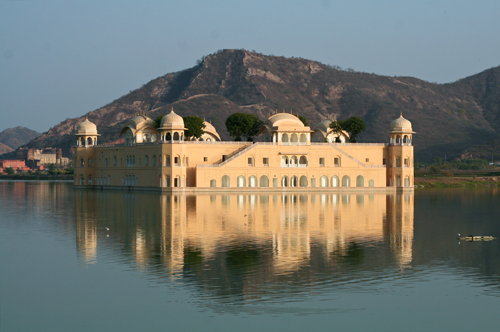
We arrived in Jaipur and our Trident Hotel, checked in, and went over tomorrow’s itinerary with the Jaipur AK representative. We could see the Water Palace from our balcony, so we walked over to the lake for photos and birding, with a little begging from kids, but not bad.

water-palace

As Barbara sat on the balcony to write our trip journal, a Rhesus Macaque monkey jumped up on the railing, much to her chagrin. We have been warned that these little creatures can be dangerous because they have become accustomed to humans giving them handouts, and when one doesn’t they may become aggressive. 

Tuesday, February 2  After a nice breakfast we were taken to Amber Fort by Badel and our Jaipur guide, Davindar. He was a very good guide, knowledgeable, good English, personable. The Amber Fort was once the capital of the state of Jaipur, until 1728. It is very large with a combination of Mughal and Rajput styles with frescoes, carvings and mirrored décor.

amber-fort

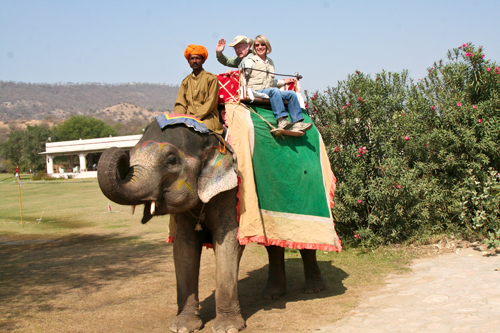
We then stopped at a gem factory, and they showed us some beautiful stones in hopes that we would do some shopping. We went on to Deva Amer where we rode on an elephant through the wilderness area. We were a little nervous about it at first, but we both enjoyed the experience a lot.

elephant-ride

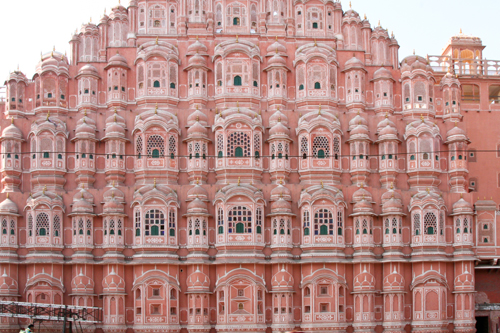
Nice lunch there. Back to the city to see Jantar Mantar, a fascinating outdoor observatory with large geometric structures for measuring time, celestial movements, etc. Then we moved on to City Palace to tour the museum and grounds. We stopped to take photos of Hawa Mahal, a red and pink sandstone façade built in 1789 for the women of the royal harem to look out one of the 953 small windows to see what was happening on the street below.

pink-facade

Our last stop was to look at carpets and textiles. Barbara chose a fabric and pattern at 5:00 to be made into a blouse, and they delivered it to our hotel at 7:00 as promised. It fit perfectly. This was a very busy but enjoyable day.

Wednesday, February 3  We got up at 4:40 to leave for the airport at 5:30 for our 7:00 flight to Udaipur. Everything went smoothly. The AK representative in Udaipur took us to the Trident Hotel. Our beautiful room was ready early, so we had a chance to have breakfast before leaving to tour the City Palace where the Maharana family still lives. It is a huge palace begun 400 years ago and still being enlarged..

palace

Then on to see the Crystal Gallery with the world’s largest collection of cut crystal. We stopped to see how miniature painting is done, but did not stay to see the “sales room”. We are getting a little tired of being “encouraged” to buy the local art. Back to the hotel for lunch and some rest before taking a boat ride on Lake Pichola to see the city from the lake. We stopped at an island palace where Mughal Shah Jahan, builder of the Taj Mahal, lived in exile from his father. Back to the hotel to walk around the beautiful grounds. So thirsty for a cold beer, but no alcohol is sold from January 31-February 4 due to elections.

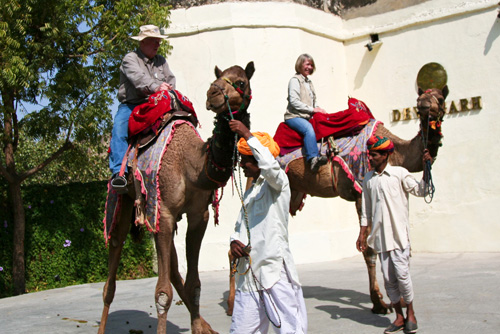
Thursday, February 4  More relaxing start this morning. We walked through the Garden of the Maids of Honor. Peaceful gardens, no fountains going due to major drought. Then on to Jagdish Temple, built by Maharana Jagat Singh in 1651. No photos were allowed. We left our shoes and socks outside. We bought marigold strands to leave as an offering at the huge black stone image of Vishnu. There were two priests reading scripture, and two men playing a drum and an accordion-type instrument. Being in this active temple was quite a moving experience. Our guide, Vic, is a Hindu and gave prayers. He gave himself and us a “third eye” of sandstone and saffron. From there we drove out of town to the old temples dedicated to Shiva. They were similar to those at Khajaraho, but not as many. We drove through the beautiful old Aravalle Hills to the 18th century Divi Garh Fort Palace high above the valley. We enjoyed a wonderful lunch there at their very contemporary white dining room. From there back to the entrance gate, we rode on camels. They laid down for us to mount up, then we were advised to hang on tight as they awkwardly got up, back-end first, nearly pitching us off over their heads. Camel rides are much bumpier than elephant rides, but a treat nonetheless. Back at the hotel we went birding and walking to the “sister hotel”, the Oberoi, and back.

camel-ride