West Coast Pelagic-birding Cruise April 14-18, 2013

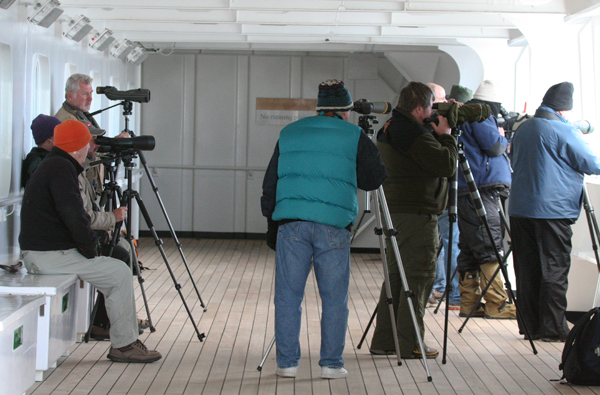
       Between April 14th and April 18th this year Barbara and I cruised along the west coast on the Holland-America cruise ship, the Zaandam.  The ship was repositioning from its winter cruise grounds south of San Diego, to Alaskan waters.  Although we are not regular “cruisers” this particular trip interested me because of the opportunity for finding some “pelagic” birds along the route to Vancouver.

        High on my list was a “Scripp’s Murrelet”.  This bird was known as Xantus’s Murrelet, but it was given its new name when Xantus’s Murrelet was split very recently into two species, one the Scripp’s Murrelet and one, generally found in Mexican waters, called the “Guadaloupe Murrelet”.  I did not see any Murrelets and I don’t think any of the other birders on board saw any either (there were about 15 of us dedicated birders among the almost 900 guests on board).  Oh, well, hopefully there will be another day for that search.

Another of my target birds was Cook’s Petrel.  I was a little hampered by back problems which delayed my morning activities, particularly on the morning when everyone else saw several of them.  Strike 2 on me.

img_9729-for-blog

Third among my objectives was Murphy’s Petrel.  Fortunately, they showed up in relative abundance and this became my North American bird number 717.

An unexpected bonus bird appeared in the form of a single Hawaiian Petrel.  I don’t think anyone expected to find this Hawaiian based pelagic this close to North America (we were cruising about 30 to 50 miles off the California shore at the time).

We enjoyed our experience on the Zaandam.  The food was good, the rooms were very nice and the ride was relatively smooth.

img_9726-for-blog

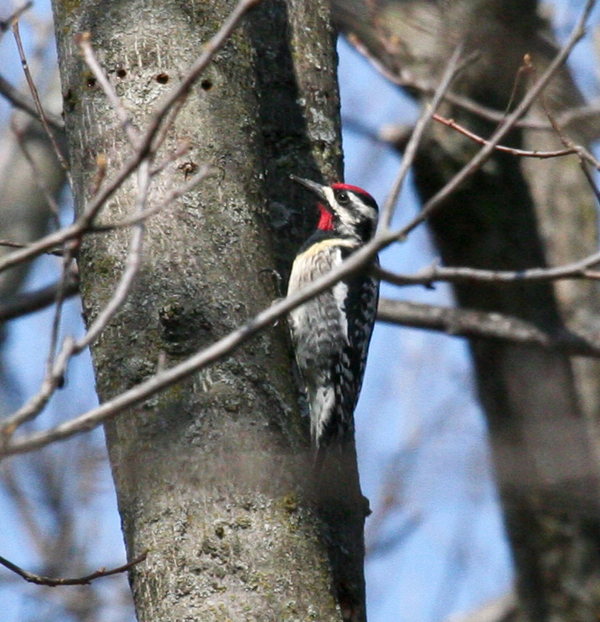
Yellow-bellied Sapsucker

Every spring I look for Yellow-bellied Sapsuckers in my back yard here in West Des Moines, as they migrate north to their breeding grounds.  Sometimes I find none, but this year was a banner year.  At least four individuals showed up one early April day.  Here is a picture of one of them, as he worked over one of the bigger trees in our ravine looking, I suppose, for sap.

blog-photo


Black Rosy-Finches at Sandia Crest, New Mexico – January 2013

Prior to January 26 of this year I had not seen a Black Rosy-Finch.  Black Rosy-Finches are an ABA Code 2 species.  The ABA lists about 670 North American Birds in Codes 1 (~494) and 2 (~176).  Here is what the ABA says about its Codes 1 and 2:

“Regularly occurring North American avifauna.  Includes regular breeding species and visitors.  There is no firm designation between Code-1 and Code-2 species, except that logically Code-1 species are more widespread and are usually more numerous.  Code-2 species have a restricted North American range, are more widespread, but occur in lower densities, or are quite secretive making their detection often difficult.  We readily acknowledge that some Code-2 species are harder to find than some species that have higher codes.”

I have seen all but one of the Code 1 species.  The one I have missed is the Mexican Whip-poor-will.  Until a couple of years ago, this species was not separated from the Whip-poor-will and I have seen quite a few Whip-poor-wills over the years, but never, to the best of my recollection, one of the southwestern race, C.v. Arizonae, which has now achieved separate species status under the name, “Mexican Whip-poor-will”.  I suppose a trip to southeast Arizona will be on my itinerary soon, so that I can (once again) claim a sweep of the Code-1 species.

I found out about the Black Rosy-finches of Sandia Crest through the excellent website of approximately the same name.  I have made previous efforts to find this bird in various areas of the Rocky Mountains, without success.  This time was different.  The drive from Albuquerque to Sandia Crest was short, but the last 10 miles were a bit dodgey.  The fog became quite dense and the winds were high, but on the other hand, there was virtually no traffic and the temperature stayed at 33 or above.  So I arrived at Sandia Crest (altitude about 12,000 feet) about 9:00 a.m. and as I pulled into the parking lot, where there were no other vehicles, a flock of about 40 Rosy-finches was feeding on the edge of the lot.  Most of them were Black Rosy-Finches, with a few Brown-capped Rosy-Finches mixed in.  I did not see any Gray-crowned Rosy-Finches in the group, but the lighting was pretty grim with all the fog and wind and I could have missed them if they were there.

I had no photographer with me to rely upon, so I tried to use my little point and shoot camera to get some pictures.  They all failed miserably due to the fog and my ineptitude.  The best I could do was to get a “profile” of the flock of Black Rosy-Finches in a bare tree near the parking lot.

black-rosy-finch-1

black-rosy-finch-2

I did get some good close-up views with my binoculars, so my identification is solid.  Hurrah!!!  Number 715 on my North American Life List, and (unless more splits occur) only 10 more Code-2s to find:  Mottled Petrel, Whiskered Auklet, Bluethroat and McKay’s Bunting (all probably only to be seen in or near Alaska); the newly recognized species, Nanday Parakeet, Mangrove Cuckoo and Antillean Nighthawk (all probably only to be seen in Florida), Black Swifts (I have a line on a place to find them this spring in Colorado), Scripp’s Murrelet (until December, 2012 conspecific with Guadalupe Murrelet under the name Xantus’s Murrelet), off the coast of California, and the bane of my life, Sooty Grouse (formerly conspecific with Dusky Grouse under the name Blue Grouse), which I have searched for several times since it was split from the Sooty Grouse, but with no success.  Any suggestions, anyone?

Red-flanked Bluetail in Vancouver – January 2013

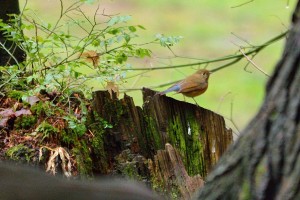
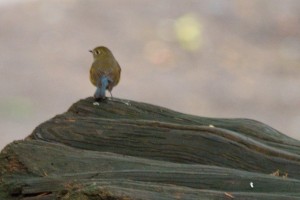
NARBA (North American Rare Bird Alert) has been reporting for quite a few days that a Code 4 Red-flanked Bluetail was being seen in Queen’s Park, New Westminster, British Columbia.  I traveled there on January 25th and found my way to Queen’s Park.  Several people with binoculars or big cameras were wandering about, quite obviously in search of the same bird that I had come to see.  One of them, a local resident, Ken Kennedy, took me under his wing and guided me to the area where he had seen the bird on prior days.  Sure enough, within minutes the little wanderer showed up and I was delighted to get views of him, making this my North American Bird # 714. Not only that, but along came a birder from Seattle, Hank Elliot, who took some great pictures of the Red-flanked Bluetail and he has allowed me to publish a couple of them on my blog.

DSC_5759_Red-flanked Bluetail 2DSC_5749_Red-flanked Bluetail 1

Primarily an Asian species, the Bluetail has been seen previously in the western Aleutians, but seldom, if ever, as far south and east as Vancouver.  This one appears to be a young male, not quite as blue as an adult male, but showing more blue than the female of the species.  I stayed overnight at Haddon House B & B in nearby Burnaby, which I highly recommend.  Johannes, the proprietor, directed me to a wonderful neighborhood restaurant for dinner, Hart House, and it was delicious.  I particularly recommend the Parsnip Soup Voloute.  Not to be outdone in culinary prowess, the next morning Johannes prepared a bountiful breakfast spread including one of the nicest omelettes that I have demolished in a long time.

LaSagra’s Flycatcher and Parakeets in Miami

In mid-January Barbara and I went to Miami to search for a La Sagra’s Flycatcher, a Western Spindalis and a Banaquit, which were being seen on Virginia Key or on Key Biscayne as reported on the North American Rare Bird Alert.

We found the La Sagra’s Flycatcher (my North American #712) without too much difficulty, along a stretch of road near the Sewage Treatment plant on Virginia Key.

lasagra-flycatcher

A couple of days of searching failed to turn up the Western Spindalis or the Banaquit, although the former is still being seen on Virginia Key and the latter on Key Biscayne. We were among a significant group of birders who struck out during the days we were looking for these two rarities.

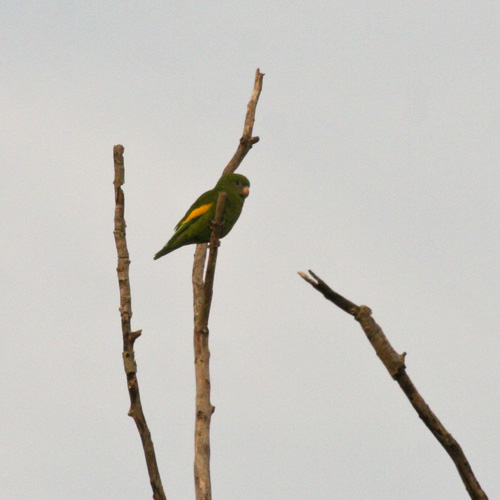
But the trip was not nearly the failure that a one-for-three result might imply. On several prior visits to Miami, I have looked for White-winged Parakeets, but never found them. On this trip, while again searching for White-winged Parakeets in north Miami, I spied two likely suspects perched in dead tree. At the time I thought they were Yellow-chevroned Parakeets, but after viewing Barbara’s photos, I am not sure of that. Maybe they are White-winged Parakeets.

yellow-chevroned-parakeet

I welcome any input from birders more familiar with the subtle distinctions between the two species who may chance to read this blog. Unfortunately, they did not fly so I never saw white (or lack thereof) on the wings.

Formerly conspecific with the White-winged Parakeet and together known as the Canary-winged Parakeet, the Yellow-chevroned Parakeet and the White-winged Parakeet were split into two separate species by the bird scientists a few years ago. The Yellow-chevroned Parakeets have not been recognized as “countable” by the American Birding Association (although they are now in fact more numerous than the White-wings).

Believing that I had not yet seen any White-winged Parakeets, on the afternoon before our return, following some tips from birders we met on the Keys, we drove to a car lot on a busy and noisy LeJeune Avenue, just south of the Miami Airport. The traffic was unbelievably loud, and was enhanced by very loud music broadcast at the car lot. The young men who worked at the car lot, however, knew just what we were looking for and helpfully pointed out the very tree where parakeets most often could be seen. They told us that the birds often flew back and forth between the car lot and Ocean Bank across LeJeune Avenue, where there were several large palm trees. We stuck it out at the car lot until dark, with no results. The next morning, however, we returned for a last ditch effort before going to the airport, and within minutes, several White-winged Parakeets (my North American list # 713) attracted us to the designated tree, where we were able to observe them briefly, before they flew across the street to the palm trees at the Ocean Bank “outdoor atrium”. We followed them, and Barbara was able to photograph them as they preened among the palm fronds.

white-winged-parakeet-1

white-winged-parakeet-2


The highlight of this trip, however, was not the birds, but the opportunity to join some first cousins once-removed, most of whom we had never met, at a family gathering and excellent dinner at one’s home in Coconut Grove. We had a great time with them.

Rufous-capped Warbler, Nutting’s Flycatcher and Rosy-faced Lovebirds — Arizona, January, 2013

We made a quick trip to Arizona on January 6th to look for two potential Life Birds:  Rufous-capped Warbler (an ABA Code 3) and Nutting’s Flycatcher (an ABA Code 5).  Both were being seen regularly at specific, but widely separated, locations.

We stayed in Green Valley the evening of our arrival and drove up to Florida (pronounced “Floreeda”) Canyon early the next morning.  We hiked up and down Florida Canyon several times looking for the Rufous-capped Warblers.  Several other birders were doing the same thing.  We arrived about 8:30 a.m. and at about 2:30 p.m. after a picnic lunch and a short rest at the dam, we decided to take one last hike back up the canyon.  All but one of the pairs of searchers that we had encountered during the day had departed.  As we neared the end of our last upward climb, Laurens and Louise Halsey motioned us to proceed forward quickly, as they had just seen the Bird.  After a brief search, it was relocated and we saw it close and well and for quite some time.  We thank Laurens and Louise who were very helpful to us in relocating this lovely little life bird.  Laurens is a professional Birding and Nature Guide and he can be contacted at www.desertharrier.com, desert-harrier@cox.net or 520-237-1284.    The Rufous-capped Warbler became number 709 on my North American Life List, and number 52 of my favorite family, the Parulidae, or Wood Warblers.

rufous-capped-warbler

That leaves me yet to find a Crescent-chested Warbler (ABA Code 5), and a Fan-tailed Warbler (ABA Code 4).  Two other potential North American Parulidae Life Birds I have seen in Central America  but not in “North America” as presently defined for ABA purposes:  Grey-crowned Yellowthroat (ABA Code 4) and Golden-crowned Warbler (ABA Code 4).  I’m hoping for one of them in the next year or two.

From Florida Canyon, we drove to Parker, Arizona and found a motel and a nice little Mexican restaurant where we enjoyed a delicious dinner and a glass of beer.  We took our time getting started the next morning for the short drive to Planet Ranch Road, a few miles north of Parker, to look for the Nutting’s Flycatcher (ABA Code 5).  I had looked for it for a full day a couple of weeks earlier without success.  As we inched our way up the very primitive road to mile marker 2, where the Flycatcher has been seen, we met the only other birder on the road, John Battalio from Boise, Idaho.  He told us he had just seen the Nutting’s Flycatcher (darn, why had we delayed our morning start??).  We joined him walking along the road and soon Barbara spotted the target bird, which proved very cooperative in perching nearby for close-up photos.  And so, the trip was a success, with two for two of our target birds sighted and a chance we could get back to Des Moines that day.  Here is one of Barbara’s photos of the Nutting’s Flycatcher.

nuttings-flycatcher

As we visited with John, he mentioned that he had come from Phoenix the day before, where he had seen several of the very recently approved addition to the ABA North American Bird List, Rosy-faced Lovebirds (ABA Code 2).  He gave us directions to Encanto Park and we decided to drive to Phoenix right away to look for them, and, if successful, to try to get a flight back to Des Moines later in the day.  When we drove into the Encanto Park golf course parking lot, the noisy little Rosy-faced Lovebirds appeared by the dozens in the trees around the parking lot.

rosy-faced-lovebirds

We ended the trip with three for two new life birds, which was a much more exciting result than my prior one for three trip in December.

Falcated Duck in California

It took a while to rest up from the trip to Papua New Guinea in August, 2012.  Much of my birding for the rest of 2012 was confined to my own back yard here in West Des Moines.

I participated in the Red Rock Christmas Bird Count in late December.  Among the better sightings on that gray, cold, drizzly day were a pheasant, 100 or so Snow Geese, 5 Trumpeter Swans resting on a plowed hillside, 2 Swamp Sparrows and a Northern Shrike.  On December 22 I participated very casually in the Des Moines Christmas Bird Count, by noting whatever showed up in my back yard.  The only species that was different from what all the other participants were able to identify was a pair of Common Grackles hanging out by my feeders.

On Christmas eve my son-in-law spotted some large, white birds flying toward my house from the west.  I was able to get the binoculars out in time to identify the 11 Trumpeter Swans that were flying eastward through the mist, like angels going to find the Babe.  It was a beautiful sight, and to add to the pleasure, these were the first Trumpeter Swans that I have ever seen from my yard, so they became my Yard Bird number 155.  (I have lived here for about 28 years).

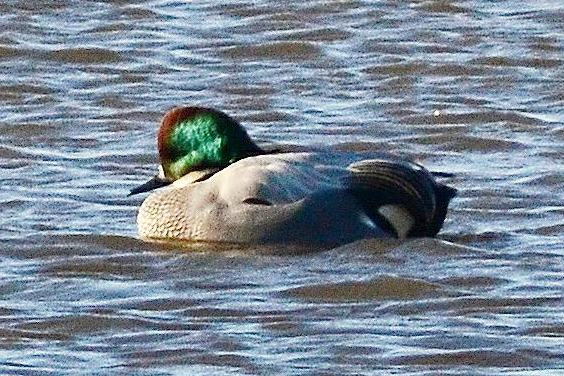
On December 18th I flew to San Francisco where I rented a car and drove northeast to the Colusa National Wildlife Preserve.  A Falcated Duck, which I have never seen, was being seen there on a regular basis.  The afternoon was clear, windy and cold, following upon the heavy rains of the preceding few days.  Colusa is a very special place.  Thousands of ducks, Snow Geese, other geese and other water birds winter there.  Two other birders and I arrived at about the same time and after an hour or so spent scanning the thousands of ducks and geese, hunters’ guns spooked nearly all the geese and I was able to spot the Falcated Duck, actually quite close (my North American Life Bird number 708).  One of the other birder’s, Lew Milligan, got a good photograph, and with his permission, I am posting it here.  Thanks very much, Lew, and good birding to you.

I drove back to San Francisco and flew to Los Angeles where a White Wagtail (which would also be a new North American Life Bird for me), had been seen for several days on the Outer Cabrillo Beach in San Pedro.  I arrived early and spent the whole day, but the bird did not show (and has not been seen since).  The hours spent lounging on the rocks in the sun while the waves lapped the beach and shoreline rock, was a decent consolation.  I left in time to catch a flight to Las Vegas and drive to Lake Havasu City, Arizona, where I hoped to find the third of my “life-bird” trip targets, a Nutting’s Flycatcher.  One had been reported at mile marker 2 of Planet Ranch Road, south of Lake Havasu City. Planet Ranch Road is posted as “Primitive”, and lives up to its billing.  I was able to maneuver my little rental car around the rocks and wash-outs, arriving at Mile Marker 2.  The day was a bit chilly and windy, but not too bad.  I spent it walking up and down the road, exploring a few trails off road and warming up in the car now and then.  The Flycatcher was very reclusive, and I neither heard nor saw it.  (It has been seen there again in recent days).  Net result of the trip:  1 for 3.

My statistics for the year 2012:  91 species of “Yard” birds; 143 species of “Iowa” Birds, 2 new North American Life Birds (Purple Sandpipers in Maine in January and the Falcated Duck in California in December); 4 new Iowa Life Birds (Cinnamon Teal, Arctic Tern, Roseate Spoonbill (believe it or not) and a Townsend’s Solitaire.  Lifetime totals to date:  North America, 708; Iowa, 332; Yard, 155.  I haven’t made a count of the species that I have seen elsewhere in the world, but if I get bored enough in the next few winter months here in Iowa, I will probably try to calculate that.

This “empty nest birder” wishes all of you birders around the world (and anyone else who happens to open this blog) a happy and productive year in 2013. Birding is a wonderful hobby, whether you are traveling to the remote corners of the earth or sitting on your own back deck.  I am looking forward to adding a few new species to each of my lists in 2013.

Birding in Papua New Guinea-Kiunga and Kivatu Camp – August 3-6, 2012

On the morning of August 3 we were to drive from Tabubil to Kiunga.  The van was 2 hours late, purportedly because there was a gas shortage in Tabubil because of low water on the River and consequent delay of the oil  tankers.  Along the way we stopped at a country-side roadside market for a little lunch.

lunch-sml

Boiled eggs and a package of cookies sufficed for me.  After arrival in Kiunga we birded Boystown Road in the afternoon.  The next day we started on Boystown Road and finished the afternoon on K17 Trail.

New birds for the trip seen on the 3rd and 4th were a Little Ringed Plover, Beautiful Fruit Doves, Pinon’s Imperial Pigeon, Zoe’s Imperial Pigeons, Yellow-capped Pygmy Parrots, Yellow-streaked Lory, Dusky Lory, Papuan King Parrots, Double-eyed Fig Parrots, Ivory-billed Coucal, Dwarf Koel, Moustached Tree Swifts, Papuan Needletails, Red-bellied Pitta, Flame Bowerbird, Yellow-gaped Honeyeater, Glossy-mantled Manucode, Trumpet Manucode, and Greater Birds-of-paradise in a spectacular display.  A large number of other birds, previously seen, were seen again during these two days.

On the 5th we boarded boats for a trip to the Fishing Camp (Kivatu Camp) by way of the Fly River, the Elevala River and the Kivaki River.  The rivers were all very brown and bordered by jungle.  Very few human habitations were seen.  The mud banks furnish the pervasive color.  The water trip was very pleasant in spite of intermittent sprinkles and the need for umbrellas to buffer the wetness.  We were warned that the Camp was basic-very basic.

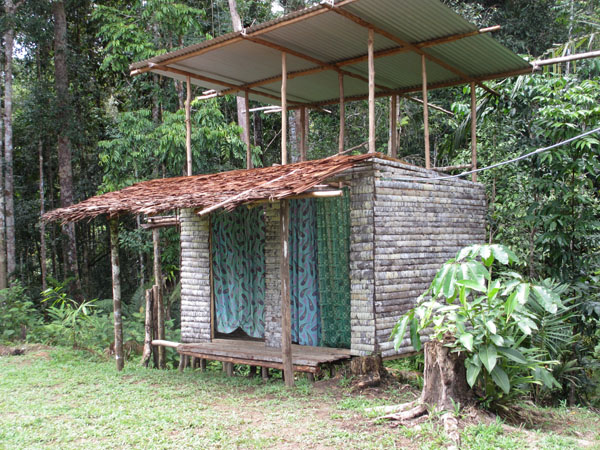
camp-showers-sml

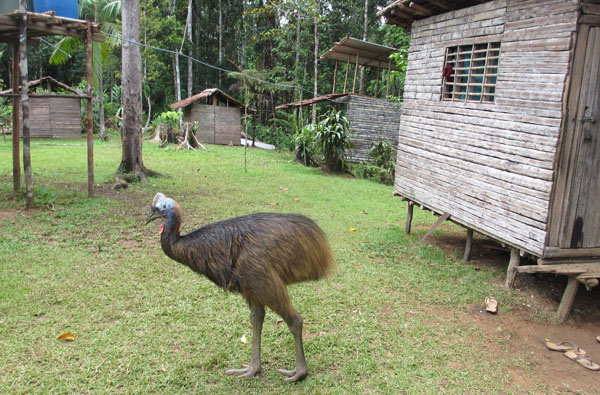
Outdoor privies and showers, mosquito netted cots that did nothing to keep out the insects at night and generally poor food were all a part of the price of staying somewhere reasonably close to sites where Twelve-wired Birds-of-Paradise and King Birds-of-Paradise can usually be found. Of course, the local Cassowary took full advantage of the food provided for it at the Camp.

cassowary-camp-sml

To add to the discomfort, the Camp had overbooked to accommodate a group of Chinese photographers, so we had to double up (triple up in my case) to have a place to sleep that night.

Discomforts aside, the birding was good here.    Birding on the rivers and on the trails near the Camp yielded some very lovely new birds, including Black Bittern (great view), Nankeen Night Heron, Great-billed Heron, a perched White-bellied Sea Eagle, Grey-headed Goshawk, a New Guinea Flightless Rail (seen from a blind after a long walk in the muck and wait), a Great Cuckoo Dove, several really spectacular Southern Crowned Pigeons, Dwarf Fruit Dove, a large flock of Channel-billed Cuckoos, Long-billed Cuckoo, good looks at Blyth’s Hornbills, Common Cicadabird, Golden Monarch, and, of course the unbelievably brilliant King Bird-of-paradise and the very strange Twelve-wired (I counted them) Bird-of-paradise.

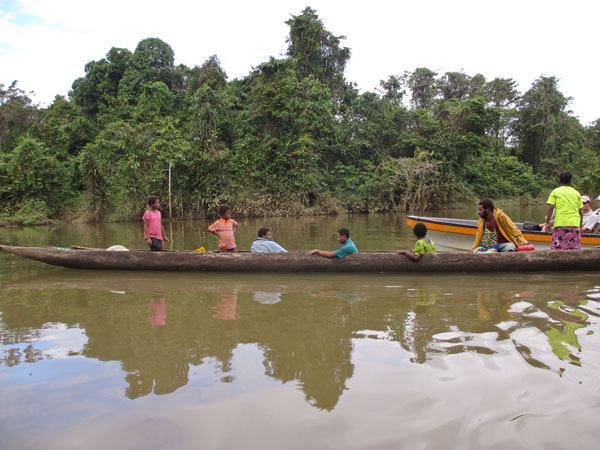
The return trip on the Rivers was not without incident.  We had two boats.  The motor on one of them stopped working.  After much effort, it would start, only to die within minutes.  Consequently we were barely drifting along, for an hour or so.  Then, from the side of the river, appears a long boat with a family.

river-rescue-sml

The man is a motor repairman.  He heard the starting problems from his riverside village, and loaded the household on his longboat to come to our rescue, which he did with dispatch.  Everyone was relieved that we could finally make way on our return to Kiunga.

On the 7th we flew to Port Moresby and enjoyed our last evening dinner together before flying to our separate destinations on the 8th of August.

Birding in Papua New Guinea-Mount Hagen and Tabubil – July 29-August 2

On the morning of July 29 we caught a flight from Tari to Port Moresby, expecting to connect with an early afternoon flight from Port Moresby to Mount Hagen.  That flight was cancelled and we spent the night, once again, in Port Moresby.  Our hotel accommodations were very nice but we had little time to enjoy them.  Except for a few birds seen on our way to or at the Tari airstrip, very little birding was accomplished.

We returned to the Port Moresby Airport early the next morning and arrived at Kumil Lodge about 1:00 p.m. the next day.  Most of the afternoon was spent birding around the Lodge.  The Lodge is located about an hour drive out of Mount Hagen, in beautiful mountainous country.  One of the nice features of the Kumil Lodge was the feeding station located off the balcony.  There we were able to see a number of birds coming and going, and the photography was a little easier for my little camera.

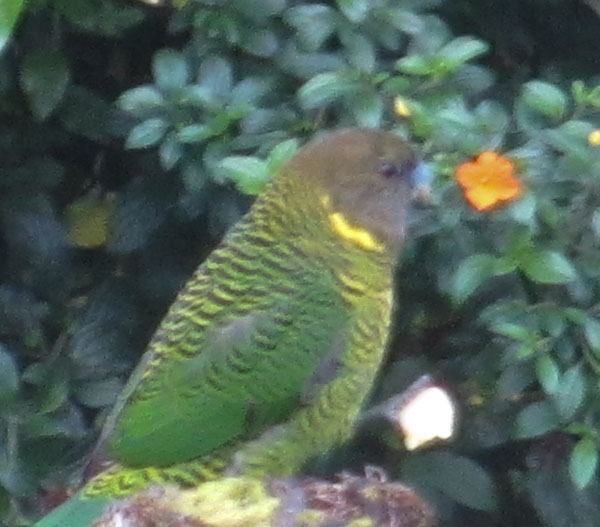
Among the birds coming to or near the feeding station were Brehm’s Tiger Parrot,

brehms-tiger-parrot-sml

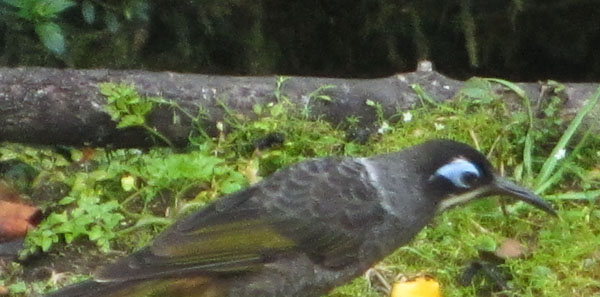
Belford’s Melidectes,

belfords-melidectes-sml

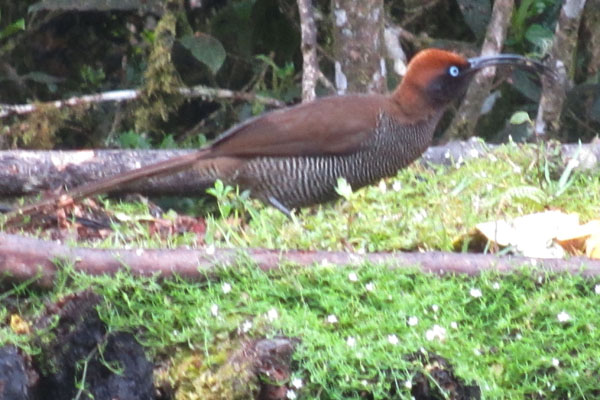
Brown Sicklebills,

brown-sicklebill-sml

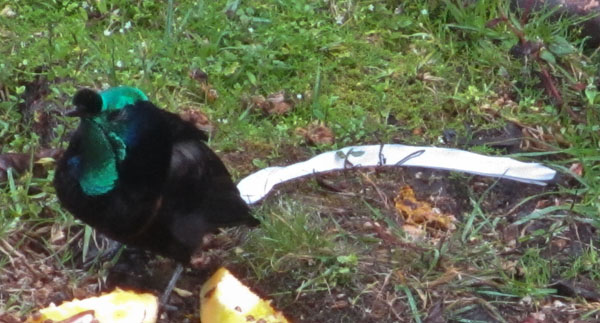
Ribbon-tailed Astrapia,

ribbon-tailed-astrapea-sml

Princess Stephanie’s Astrapia, Common Smoky Honeyeaters, Gray-streaked Honeyeaters, Ornate Melidectes, Sclater’s and Rufous-necked Whistlers, White-winged Robins, and Island Thrushes. At the very end of our stay most of us were fortunate to see an Archbold’s Bowerbird slip in under the feeders for a minute of two.

Other birds seen first on the trip during our travels along the roads near Kumil Lodge, much of it near the Lae River,  trying to find an elevation without rain or heavy fog, were Great Cormorant, Nankeen Kestrel, Yellow-breasted Bowerbirds, Ornate Melidectes, a very unusual Sooty Melidectes (a first for our guides in this area), Mountain Mouse Warblers, lovely Crested Satinbirds, Tit Berrypeckers, Regent Whistlers, Torrent-larks, Torrent Flyrobins, and Mountain Firetails.

On the morning of August 1, we drove down to Mount Hagen to take a flight from that airstrip to either Tabubil or Kiunga.  Our destination was Tabubil, but sometimes the plane apparently does not land at Tabubil, and such was the case today.  Our ground transportation assumed we would be at Tabubil and apparently drove from Kiunga to Tabubil to meet us without checking on the flight.  After a couple of hours of negotiation at the Kiunga airstrip, an alternate ground transport was arranged and we left on the long drive to Tabubil, arriving after dark.  No birding today.

On August 2 we birded the Tabubil area, including Davlin Creek in the morning and the Ok Minga area in the afternoon.  One of the highlights of the day was a pair of Salvadori’s Teal in the river by the dam.  Others seen well or first today were Long-tailed Buzzard, Metallic Pigeons, Superb Fruit Doves, Palm Cockatoos, Red-breasted Pygmy Parrots, Pacific Koel, White-eared Bronze Cuckoo, a fascinating Papuan Boobook (Jungle Owl), Spotted Honeyeater, Tawny-breasted Honeyeater, Obscure Honeyeater, Mottle-breasted Honeyeater, Scrub Honeyeater, Obscure Berrypecker, Black Butcherbird, Mountain Peltops, Stout-billed Cuckooshrike, Grey-headed Cuckooshrike, Golden Cuckooshrike, Crinkle-collared Manucodes, Queen Carola’s Parotia, and Magnificent Riflebird.

Birding in Papua New Guinea-Tari Valley – July 25-28, 2012

On the 25th we flew from Port Moresby to the Tari Valley.
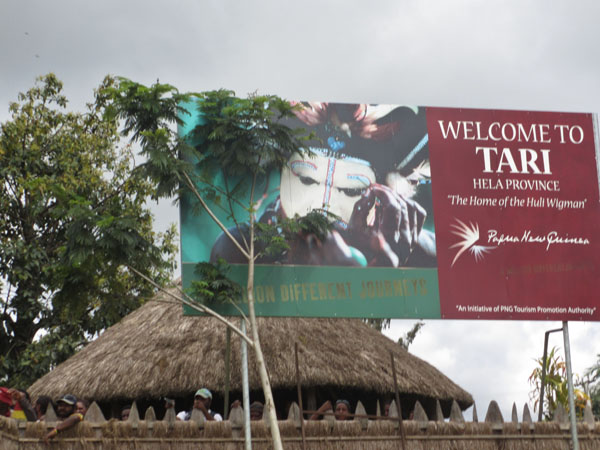
tari-sign-sml

We checked in at the Makara Bird View Lodge. We spent the afternoon birding along the local roads.
lodge-sign-sml

It was not until the 1930s that the outside world became aware that there were tens of thousands of inhabitants of this inaccessible (except by air or great effort) highland area. Gold miners from Australia looking for their fortune made their way into the area and did indeed discover gold. There is a documentary entitled “First Contact” that includes footage of the encounter between the explorers and the residents. I have not seen it, but it was described to me by one of our leaders and I plan to try to get a copy and watch it.

The Tari Valley is populated by the Huli Tribe, widely known for their “wigmen” cult. We spent part of an afternoon with a group of Huli Wigmen, adorned in their head pieces made from matted human hair and the feathers of parrots and birds-of-paradise.

don-with-wigmen-sml

The wigmen sleep on their backs with their necks resting on poles to avoid damaging the wig in process.

wigmen-sml


At 6900 feet of altitude, our lodge had a refreshing mountain climate. Our local guides were very helpful in seeking out some of the rarer and more spectacular birds of the area.

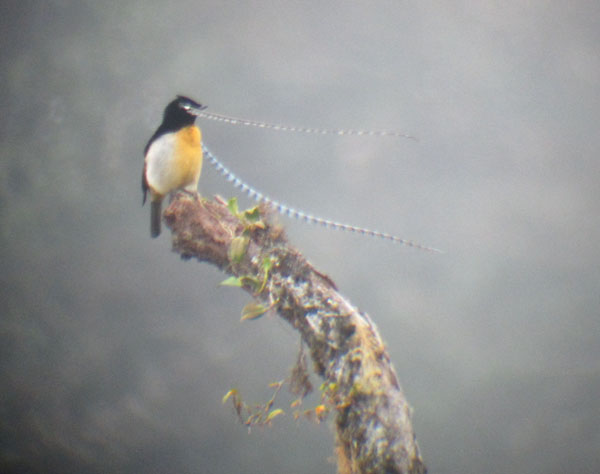
One of our first views was of the lovely King of Saxony Bird of Paradise.
king-sml

The very long and colorful feathers that protrude from its head are unique in the bird world. This was a very productive site for finding Birds of Paradise. During our stay here we had great views of Superb Birds of Paradise, with their protruding iridescent breast-shield, an unbelievably vivid Blue Bird of Paradise, Ribbon-tailed Astrapias, and Princess Stephanie’s Astrapias.

During our stay here we had to do some shuttling around to find areas that were not shrouded in fog or experiencing a steady but light rainfall. This was accomplished generally by moving up or down the mountain and we usually were able to find areas that were conducive to birding. It was a great place in spite of the weather issues. Among the birds seen at Tari Valley were: a Brown Quail, flushed from the roadside while walking, Bar-tailed Cuckoo Dove, Papuan Mountain Pigeons, Papuan Lorikeets, Plum-faced Lorikeets, Yellow-billed Lorikeets, Orange-billed Lorikeets, Brehm’s Tiger Parrot, Painted Tiger Parrot, Modest Tiger Parrot, Shining Bronze Cuckoo, Brush Cuckoo, Sooty Owl, Marbled Frogmouth, Mountain Owlet-Nightjar, Black-throated Honeyeaters, Marbled Honeyeaters, Common Smoky Honeyeaters, Yellow-browed Melidectes, Belford’s Melidectes, Grey-streaked Honeyeaters, 3 Scrubwren species, Crested Satinbird, Fan-tailed Berrypeckers, Crested Berrypeckers, Black-breasted Boatbills, Great Wood Swallows, Black-shouldered Cicadabird, Black-bellied Cuckooshrike, Black Sittella, Brown-backed Whistler, Regent Whistler, Black-headed Whistler, Long-tailed Shrike, Black Fantails, Friendly Fantails, Dimorphic Fantail, Blue-capped Ifritas, Slaty Robins, Island Leaf Warbler, Papuan Grassbirds, Capped and Papuan White-eyes, Island Thrushes, Hooded Mannikins and NewZealand Pipits.

During our stay at Tari Valley we birded at Mekara Bird View Lodge, at the “Blue BOP” (Bird of Paradise) Village, around the Tari Gap, “Benson’s” Trail and Aduakambe Village. (Benson was our able local guide).

On the morning of the 29th we flew from Tari Valley to Port Moresby where we were expecting to connect with a plane to Mount Hagen. Our troubles with internal flights continued, however, and the Mount Hagen flight was cancelled. We managed to get set up in a much nicer hotel than the first time we were stranded in Port Moresby. Our flight the next morning (the 30th) was delayed and we did not arrive at our Mount Hagen Lodge until early afternoon, in effect losing another day of birding in the whole process.