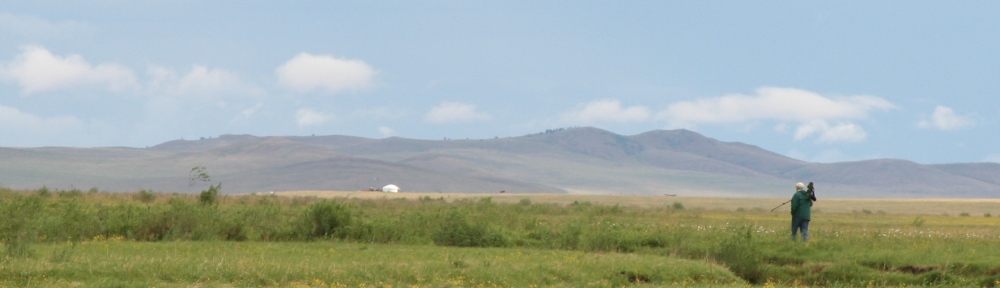
Birding in Papua New Guinea-Port Moresby Area – July 22-24, 2012

After our flight back to Port Moresby from New Britain and lunch at the Lamana Hotel, we birded on the campus of Pacific Adventist University near Port Moresby. The campus contains open areas, including gardens and patches of habitat suitable for a nice variety of lowland species. Among the new and more interesting species seen there were Spotted, Plumed and Wandering Whistling Ducks, Green Pygmy Geese, a nice selection of egrets and herons (including a Pied Heron), Black, Whistling and Brahminy Kites, colorful Comb-crested Jacanas, Bar-shouldered Doves, Orange-fronted Fruit Doves, Torresian Imperial Pigeons, Dusky Lories, a well disguised and very odd looking Papuan Frogmouth, Blue-winged Kookaburra, Fawn-breasted Bowerbirds and New Guinea Friarbirds.

The next morning we departed early to the Varirata National Park, located in the foothills above the city. On the way, we passed the trailhead of the notorious, and still honored, Kokoda Trail, where, with great suffering and loss of life, the Australian and local Papuan troops halted the Japanese march during the Second World War. Dry eucalyptus forests line the quiet access road to the park. Once in the park we spent the morning slowly walking the narrow trails that criss-cross the moister evergreen hill forest. From there we had some excellent views of Port Moresby and the coastline. Our bird of the day was intended to be the beautiful Raggiana Bird-of-Paradise. We were not disappointed. The colorfully plumed males were in full cry throughout the park as they sought to inspire the interest of the drabber, but quite lovely in their own right, females of the species. Unfortunately, my little point and shoot camera could never quite get a good picture as these birds cavorted through the tops of the tall trees, so you will have to Google Raggiana Bird-of-Paradise to see what this great bird looks like.

Among the nicer “incidental” new birds of the day were a Brown Goshawk, Little Eagle, Slender-billed Cuckoo-dove, Pink-spotted Fruit Dove, a Barred-Owlet Nightjar, a spectacular Brown-headed Paradise Kingfisher, Rufous-bellied Kookaburra, an elusive, diminutive Yellow-billed Kingfisher, Rainbow Bee-eaters, White-shouldered Fairy Wrens, several species of plain and small Gerrygones (gerigonees, phonetically), Black Berrypeckers, Yellow-breasted Boatbill, Black-backed and Hooded Butcherbirds with their crow-like looks and surprisingly beautiful songs, Varied Trillers, Little Shrikethrush, Hooded Pitohui, Spangled Drongo, Chestnut-bellied Fantail, several Monarchs and Flycatchers, Lemon-bellied Flyrobins, Pied Bush-chat and Red-capped Flowerpecker.

On our final day in the Port Moresby area we drove to the Hisu Mangrove area by the Brown River. This is flat, hot, tangled and muddy territory. We stuck to the road, almost literally. Along the way we encountered a pig hunting party that had just had success. Two young boys of about 12 years of age or so were carrying a large sow (200 pounds, I would guess) that had been shot and tied by its feet to two sturdy poles, which the boys had somehow gotten to their shoulders as they carried the bounty along the road back to their village. They were preceded by the apparent shooter, a young man in fatigues and a very large gun, several snarling hunting dogs and a few others helpers from the village. Unfortunately, I left my camera in the bus and missed a good photographic opportunity. On the other hand, it would be difficult to make out many features because all of the participants were caked with still wet mud.

After exploring the mangrove and Brown River area we drove to Hisu Lake. To get to the lake we walked though a local farmer’s building site. After scoping the lake, we stopped at the farm where the boys harvested some fresh coconuts for us.
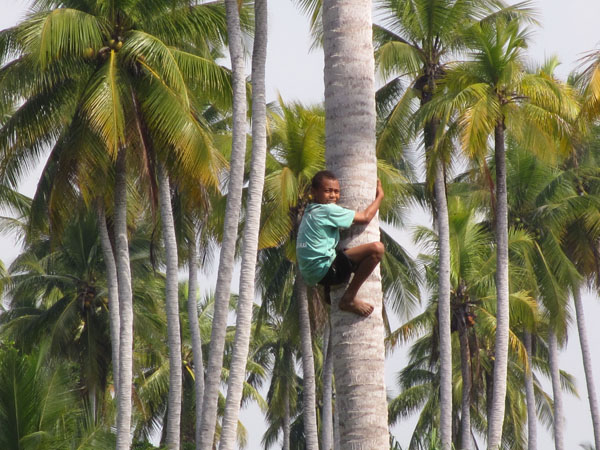
coconut-climber-sml

We sampled coconut milk fresh from the machete carved nuts. They contain a surprising amount of the sweet liquid.
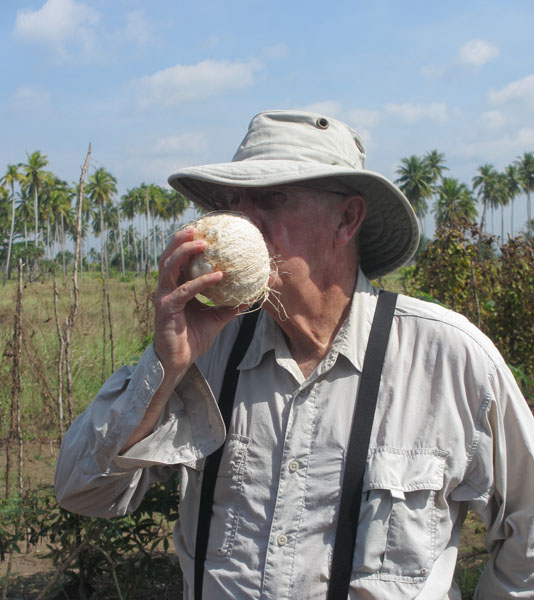
don-coconut-sml

The new and interesting birds of the day included a Striated Heron, Papuan Harrier, Black-mantled Goshawk, Swift, Lesser and Crested Terns, Coroneted Fruit Doves, Orange-bellied Fruit Doves, Palm Cockatoos, Striated Lorikeets, Red-flanked Lorikeets, Pheasant Coucal, Black-billed Coucal, Little Bronze Cuckoo, Barking Boobook (Owl), Common Paradise Kingfisher, Collared Kingfishers, Brown-backed Honeyeater, Mangrove Gerygone, White-throated Gerrygone, Lowland Peltops, Grey Shrikethrush, Black Thicket Fantail, Shining Flycatchers, a Golden-headed Cisticola, Olive-backed Sunbirds, , and, on the mammal front, an Agile Wallaby.
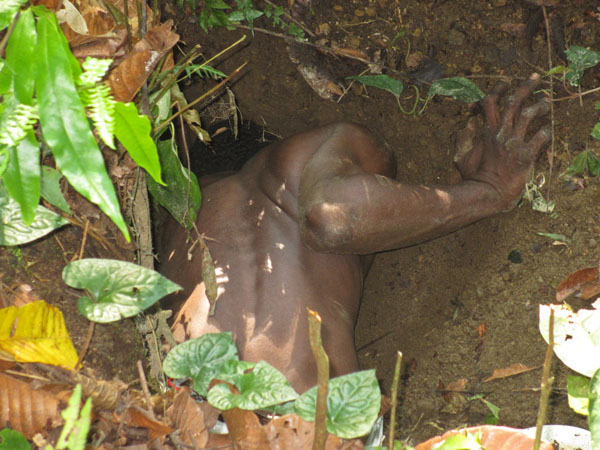
Birding in Papua New Guinea-New Britain Island – July 18 to 22, 2012

I left my hotel in Cairns about 4:30 a.m. to depart at 6:45 a.m. for Port Moresby, Papua, New Guinea.  The flight went smoothly and I met the Rockjumper leaders at the Lamana Hotel in Port Moresby.  After lunch we boarded a bus for the Port Moresby Airport to get our 3:00 p.m. flight to Hoskins on New Britain Island.  At 6:00 p.m., having spent a hot afternoon in the small and crowded  terminal, we were told that the flight had cancelled.  Several hours of negotiating with the airline and the hotels resulted in a booking for all of us in a dubious appearing hotel for the night. The Lamana Hotel would not accept the rate the airline offered.   We had vouchers for a meal at the hotel and it was barely edible.  The next morning we returned to the airport for our rescheduled 10:00 a.m. flight to Hoskins.  It left about noon and we arrived, finally, on New Britain.  The delay took a day out of our anticipated 4 days of birding on New Britain.
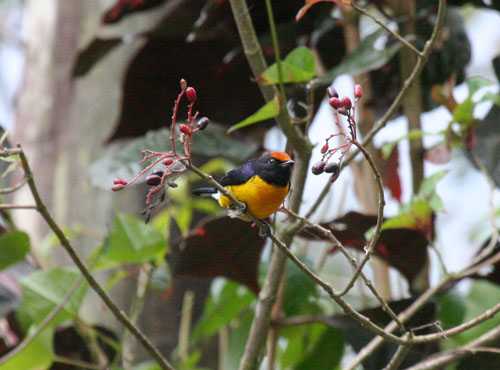
New Britain is located in the warm Bismarck Sea just to the north of mainland New Guinea. It is the largest of the string of volcanic islands known as the Bismarck Archipelago.

From Hoskins we drove to our lodge on Kimbe Bay.  The area from Hoskins to Kimbe Bay looked more prosperous than Port Moresby.  I suspect that is related to the extensive palm oil and coffee plantations and the processing plants for palm oil that line the road between Hoskins and Kimbe.  We stopped in Kimbe at the Kmart for some supplies.  The destination, our lodge at Walinde, was a welcome sight.  We all enjoyed our stay there in lovely, raised cottages, and the food and service were excellent.
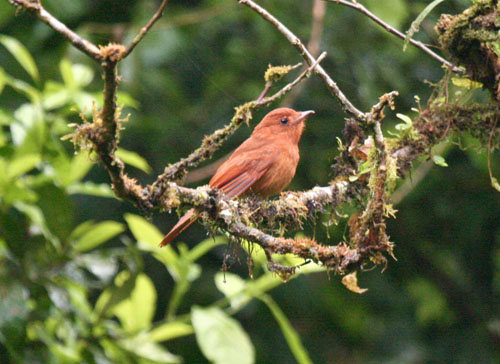
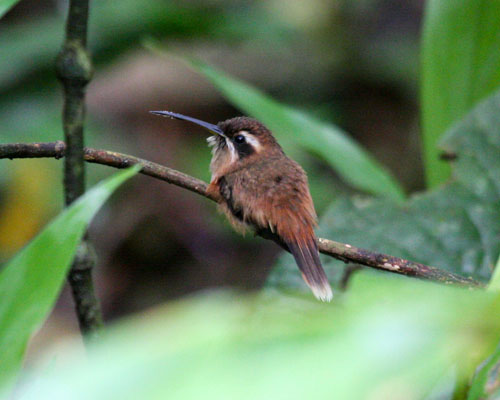
We managed to find a few birds on our drive and on a walk up into the foothills to Tomara Ridge after our arrival at Walinde by the sea.  These included Eastern Osprey, Brahminy Kite, White-bellied Sea Eagle, Red-knobbed Imperial Pigeons, Blue-eyed Cockatoos, Red-flanked Lorikeets, Eclectus Parrots, Pied Coucal, Violaceous Coucal, Moustached Treeswifts, Blyth’s Hornbill, White-bellied Cuckooshrike, Bismarck Crows, Metallic Starlings, Singing Starliings, and an impressive Flying Fox.

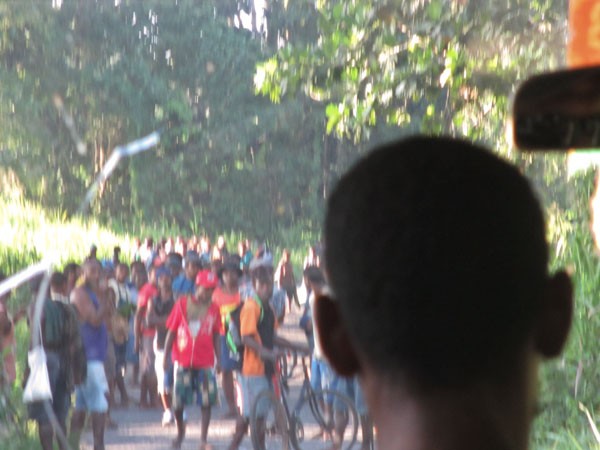
The next morning we boarded the bus again for a long, slow and bumpy ride to find the nesting grounds of the strange Melanesian Megapodes at the Pokili Wildlife Reserve.  We drove on very primitive tracks along the ocean.  As we neared the nesting grounds, our progress was halted by a mass of people blocking the road.

from-the-bus

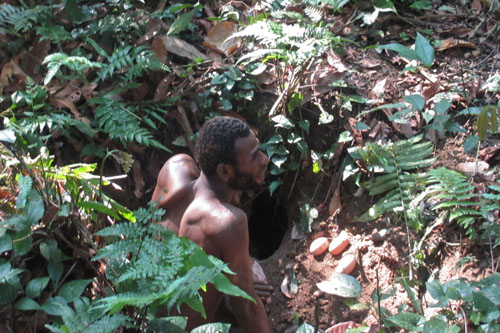
I don’t know what was said or what was done to clear the road for us, but about 5 of the local women boarded our bus and rode with us to the nesting ground.  There they joined some earlier arrivals in digging for Megapode eggs, then boiling and wrapping them.

eggs-in-hole

The eggs are a major source of protein for these folks.  Apparently they do not take so many that the birds become extinct, as there were a fair number of Megapodes skulking about in the trees.

man-with-eggs

We spent a fair amount of time in the Pokili Conservation Area, looking for other birds.  After a lot of effort by our guide, Rich, we finally were able to see a beautiful Black-capped Paradise Kingfisher in the dense understory.  During the long ride back and in the afternoon, while relaxing at the Lodge, and hiking to Kilu Ridge, we saw a number of new birds, including Pacific Reef Herons, Lesser Frigatebirds, Swift Terns, Common Terns, Knob-billed Fruit Doves, Yellowish Imperial Pigeons, a surprisingly cooperative New Britain Boobook (Hawk-owl), Red-chinned Lorikeets, Red-flanked Lorikeets, Singing Parrots, Oriental Dollarbirds, Collared Kingfishers, Sacred Kingfishers, Black Myzomela, Black-bellied Myzomela, Pacific Swallows, Black Sunbirds, and Buff-bellied Mannikins.

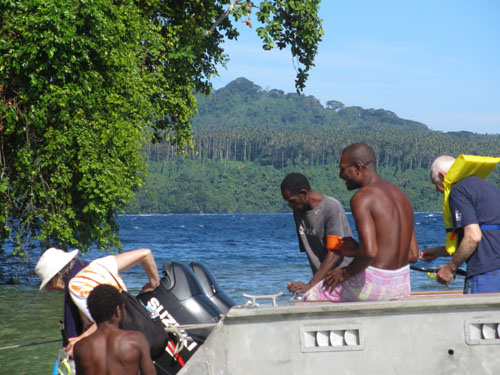
On our final day we enjoyed a boat trip to the very small Resorf Island.

boat-motor

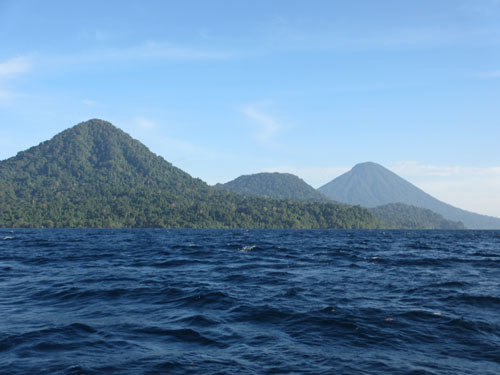
From the water, we could look back on the coast line of New Britain.

mountain-from-boat

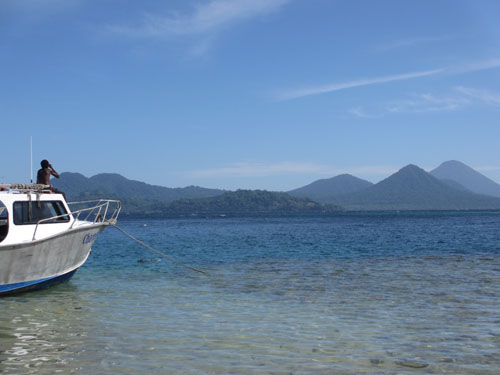
We spent a lovely morning there, snorkeling, watching for birds and eating a picnic lunch on the beach.

mountain-scenery

Upon our return we walked to the Nature Center.  New birds seen during the day included a Black Noddy, Black-naped Terns, Nicobar Pigeons, Island Imperial Pigeons, Beach Kingfishers, Common Kingfishers, Sclater’s (Scarlet-bibbed) Myzomelas, Mangrove (Golden) Whistlers, and Shining Flycatchers.

After enjoying another fine meal and night of rest at the Walindi Resort we returned to Hoskins for our flight back to Port Moresby, where the three of us who were going on met the 6 new folks that would be with us for the remainder of our trip.

Birding in Papua New Guinea-2012

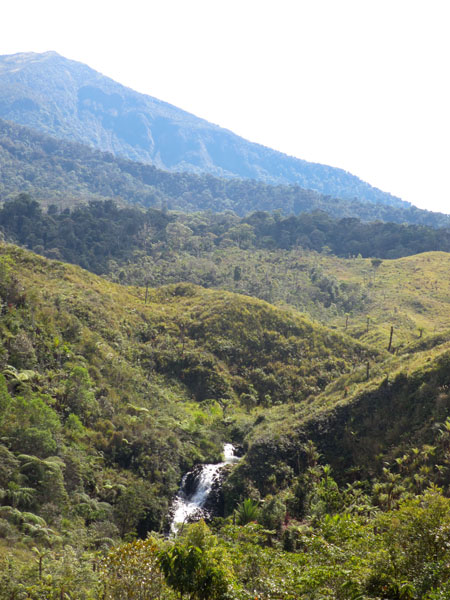
I was one of 8 or 9 participants in Rockjumper Birding’s tour of Papua New Guinea (PNG), including its smaller, adjacent island of New Britain, from July 18 through August 8, 2012.  PNG is a large, mountainous island located near the equator in the southwest Pacific Ocean, (Oceania) generally north of near-by Australia.  PNG occupies the east half of the island of New Guinea.  The west half of New Guinea belongs to Indonesia. PNG is about the size of California and has a population of 6-7 million people.  By comparison, the population of California is about 38 million.

mountains

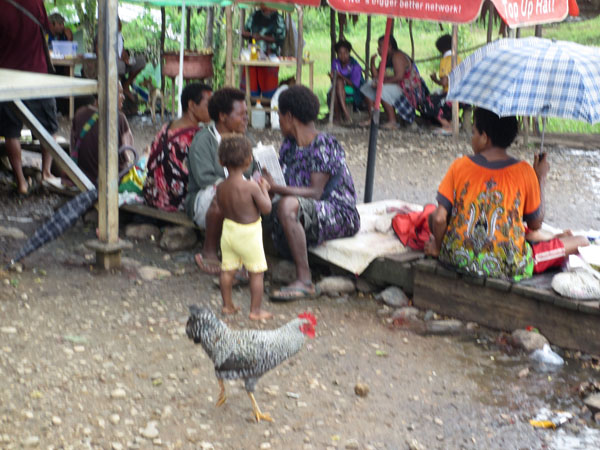
Over 800 languages are spoken by the natives of PNG, more than 10% of the total languages of the world.  Many of the languages are spoken only by tribes occupying certain villages, or small groups of villages.  Languages are often unrelated to any other, i.e., are not dialects or accents, and the speakers of one language often cannot understand their neighbors.  Most of the residents still reside in the interior of the island (the Highlands) where they engage in subsistence agriculture (mostly yams and pigs).

people-with-chicken

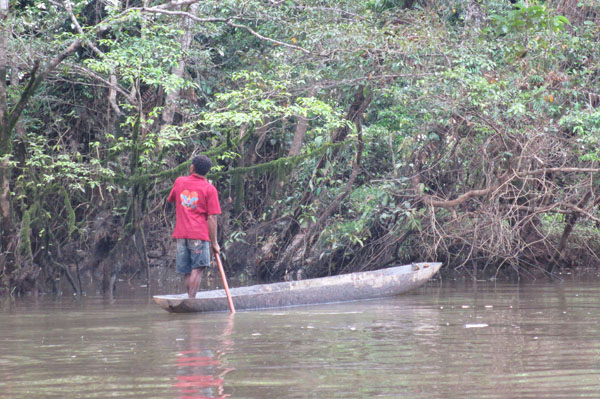
Literacy in any language is less than 50%.  There is no road system connecting the major population centers (Port Moresby and Lae) with the rest of the country.  Transportation is mostly by air or water.

man-in-boat

Until the 1900s headhunting and cannibalism were practiced by some of the interior tribes.  Land ownership is vested, if at all, in the community, or tribe or particular families within an area.  In general, an individual cannot pass ownership of land to other individuals.  Violence among neighboring tribes protecting their turf has long been an accepted way of life.  Even today, many of the men carry machetes wherever they go.  This has created serious problems within the cities as migration from the country-side to the cities is increasing, and many of the new arrivals bring with them their old animosities.

The Island was very late to be taken over by Europeans.  The Germans annexed the north half of PNG in 1885 and held it until after World War I (1918).  The British took over the south half about the time the Germans claimed ownership of the north half.  They remained in control until 1902 when they turned it over to Australia.  The Australians continued to administer the south half of PNG along with the former northern German area until the Japanese liberated PNG in 1941.  After the loss of over 200,000 lives of Japanese and Allied soldiers, sailors and marines on PNG during World War II, Australia again administered PNG until the mid-1970s, when PNG became independent.  To the surprise of many, PNG decided it wished to be a part of the British Commonwealth of Nations, and so the head of state in PNG is Queen Elizabeth.

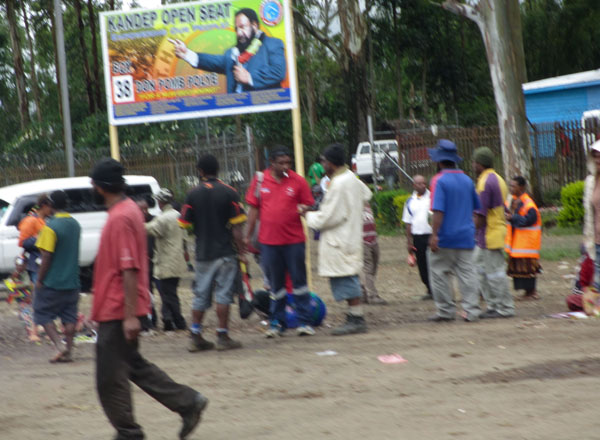
The principal spoken language of PNG is Pidgin English, called “Tok Pidgin”.  Other official languages are English (not widely spoken) and Motu (spoken by a diminishing number of older residents).  Many of the residents also speak (or only speak) one of the over 800 languages which still prevail throughout the island. I saw quite a few people reading one of two English language newspapers, which have good coverage of PNG events, especially the elections which were just then concluding, as well as a good sampling of world news.

people-with-sign

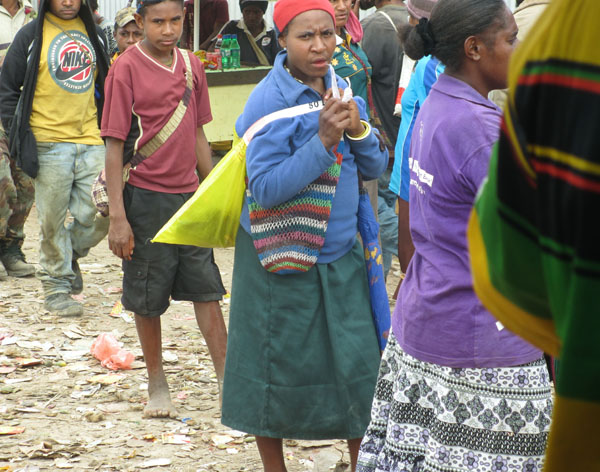
The people of PNG are generally quite poor.  At least half of the many people I saw wore no shoes.

people-in-line

PNG has considerable natural resources, such as gold, copper and nickel, and mining is a source of income for the country.  Most of the mining operations are Australian controlled.  Oil and gas is present is substantial amounts, and a couple of American companies are actively developing this resource.  Recent economic performance has been among the best in the world, but it started from a long way down.

I was attracted to PNG primarily because it is the only place in the world to see Birds of Paradise.  The Birds of Paradise family (Paradaisidae) is arguably the most spectacular of all over 200 families of birds throughout the world.   I saw most of the Birds of Paradise that could reasonably be expected on the itinerary we followed.  These, as well as the other birds seen on this exciting trip, will be noted in the posts to follow.

Australia Birding—Hawkesbury, Capertee Valley and Blue Mountains — July 13-15, 2012

I had a couple of extra days to go birding in Australia before embarking on a 3 week birding excursion with Rockjumper Tours in Papua/New Guinea. I made arrangements for guiding services in Australia with Carol Probets of the Katoomba area. I took the train from the Sydney airport to Windsor where she met me and we began our birding in the Hawkesbury area a little before noon on July 13th.

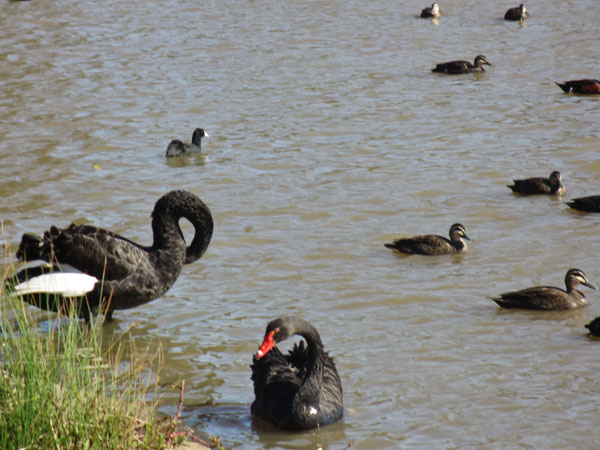
Early in the drive out of Windsor we spotted Masked Lapwings, Spotted Doves, Galahs, Magpie Larks, lots of Willie Wagtails, Australian Magpies, Pied Currawongs, Australian Ravens, Australian Pipits, Common Starlings, Common Mynahs and Welcome Swallows. We stopped for cookies and tea at a small park with significant water features. There we got close-up looks at quite a variety of water birds and some passerines: Black Swans, Pacific Black Ducks, Eurasian Coots,

swans-sml

Grey Teal, Chestnut Teal, Hardheads, Australasian Grebes, Australasian Darters, Australian Pelicans, Intermediate Egrets, Cattle Egrets, a Royal Spoonbill, Purple Swamphens, Dusky Moorhens, a pair of fly-over Yellow-tailed Black Cockatoos, Superb Fairy Wrens, a Brown Thornbill, and Red-browed Finches.

We made our way slowly into the beautiful Capertee Valley in order to arrive at our lodging for the night, the Binalong Cottage.

sign-sml

We arrived as it was beginning to darken. Along the way we saw Australian Wood Ducks, a Brown Falcon, a White-faced Heron, Crested Pigeons, a scruffy looking Wombat, Crimson Rosellas, Little Wattlebirds, Noisy Miners, Lewin’s Honeyeater, White-plumed Honeyeaters, a Grey Fantail, Grey Butcherbirds, and some Red-whiskered Bulbuls.

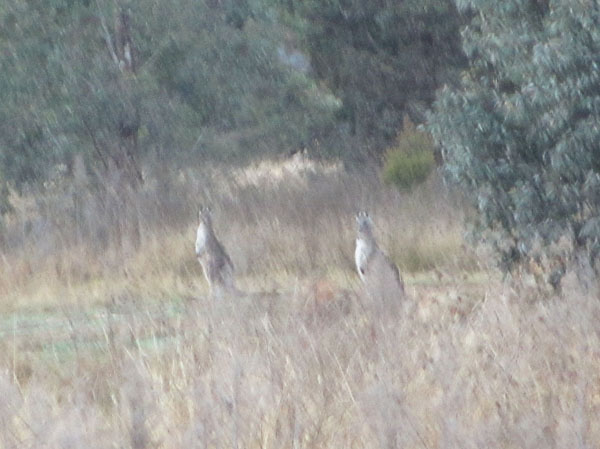
In the morning I was treated to a look at a troop of Eastern Grey Kangaroos foraging in the grasslands close by the Cottage.

kangaroos-sml

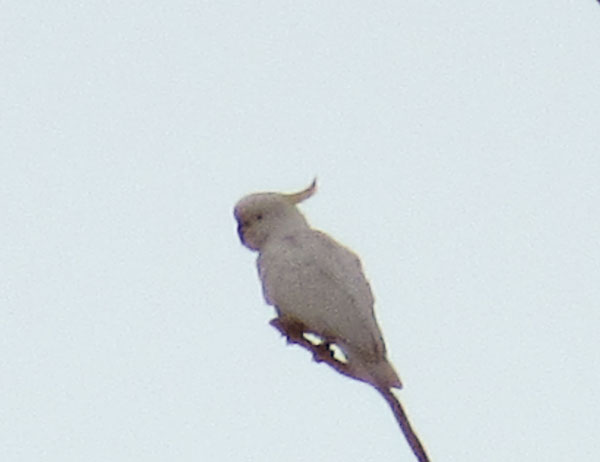
They were quite wary and disappeared quickly once they knew they were being observed. They are accustomed to being hunted by the local farmers. Before breakfast we walked along the trails and roads near the Cottage. Birds were plentiful and we saw an Australian Hobby, more Crested Pigeons, Peaceful Doves, more Galahs, Little Corellas, Sulphur-crested Cockatoos,

sc-cockatoo-sml

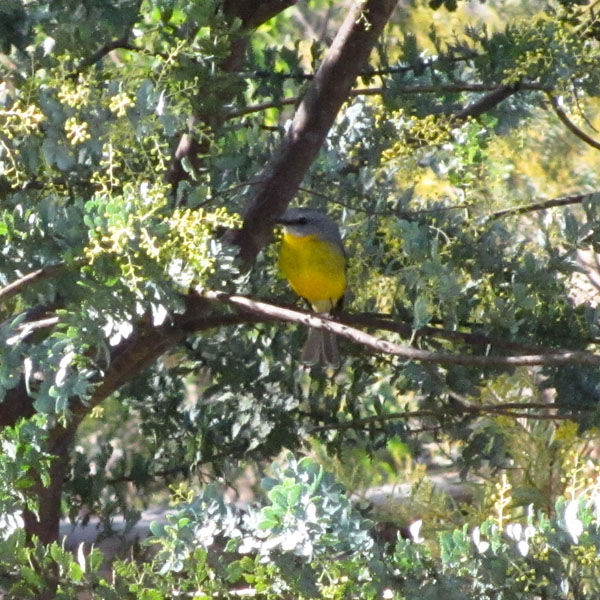
a Laughing Kookaburra, Brown Treecreepers, Yellow-rumped Thornbill, Striped Honeyeaters, Noisy Friarbirds, Fuscous Honeyeaters, Jackie Winters, an Eastern Yellow Robin,

yellow-robin-sml

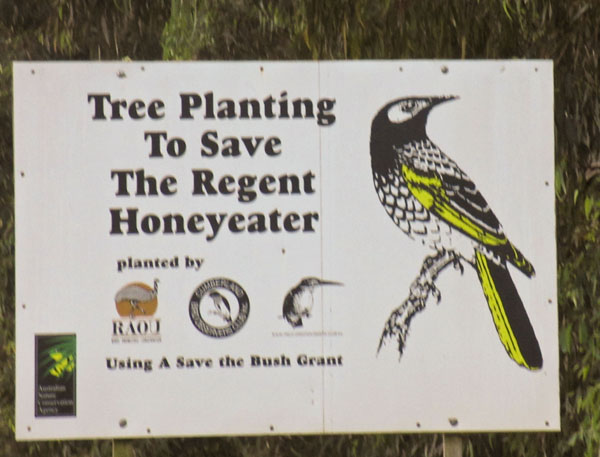
Grey Shrike-thrushes, Restless Flycatchers, a nice flock of White-winged Choughs, Zebra Finches, Double-barred Finches, Diamond Firetails, and Tree Martins. The undoubted “best bird” of the day, however, was the Regent Honeyeater, an endangered and beautiful bird. Actually, we saw at least 6 of them, and my Guide, Carol, was quite excited to find them present in such unusual numbers. The Binalong Cottage is part of a larger farm which has been dedicated to plantings of native trees and shrubs designed to help the Regent Honeyeaters survive.

In the afternoon we drove to Katoomba where I had reservations at the Three Sisters Motel. Along the way we stopped to look for birds, of course. Among those seen on this segment were Musk Ducks (very odd ducks), Australasian Shovelers, Pink-eared Ducks, Hoary-headed Grebes, Little Pied Cormorants, Little Black Cormorants, a White-necked Heron, a superb Wedge-tailed Eagle, Eastern Rosellas, Red-rumped Parrots, Red Wattlebirds, Yellow-faced Honeyeaters, Black-chinned Honeyeaters, and Common Wallaroos.

The next morning in Katoomba broke cold and very windy, so we headed down into some protected ravines and valleys. We only had the morning for birding as Carol had another client scheduled at noon. Our primary target bird was the Australian endemic, the beautiful and strange Superb Lyrebirds. They were quite vocal but very hard to see. After a lot of effort we succeeded in tracking down a displaying male in the underbrush of a heavily wooded ravine. Although I got a decent look at it, I was not able to get any sort of a picture. Nevertheless, it was a satisfying look at a bird that I remember admiring, sketched in the old unabridged Dictionary that stood on a pedestal in my country school house at Highland Township Number 1 in northern Iowa.

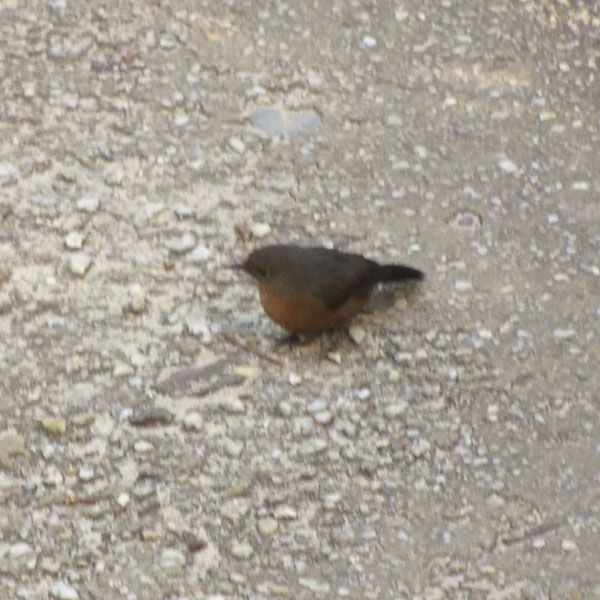
Grey-Shrike Thrushes were out in good numbers along the narrow park roads. Other birds seen that morning were more Yellow-tailed Black Cockatoos and Galahs, a White-throated Treecreeper, a Red-browed Treecreeper, Rockwarblers,

rock-warbler-sml

White-browed Scrubwrens, Large-billed Scrub-wrens, Brown Thornbills, Striated Thornbills, lots of Red Wattlebirds, White-eared Honeyeaters, White-naped Honeyeaters, beautiful New Holland Honeyeaters, and a shiny male Satin Bowerbird.

I took the afternoon off to walk about Katoomba and to hike down to the rock formation known as the Three Sisters. I saw a few birds along the way, but nothing new. The next morning I caught the train back to Sydney and after checking into my hotel for the night, walked in the very nice park along the river, south of the Sydney Airport. Among the new birds seen there were plentiful Silver Gulls, Rainbow Parakeets, and Noisy Miners.

The next morning I flew to Cairns and had time to hike to the Arboretum. There I was pleased to find Bush Stone Curlews, and an Orange-footed Scrubfowl. Toward evening I walked back along the Esplanade where there were Australian White ibis, a Black-fronted Dotterel, a Striated Heron and a few other shorebirds. Tomorrow I leave for Port Moresby, Papua New Guinea.

Peru Birding – April 2012 – Part 3

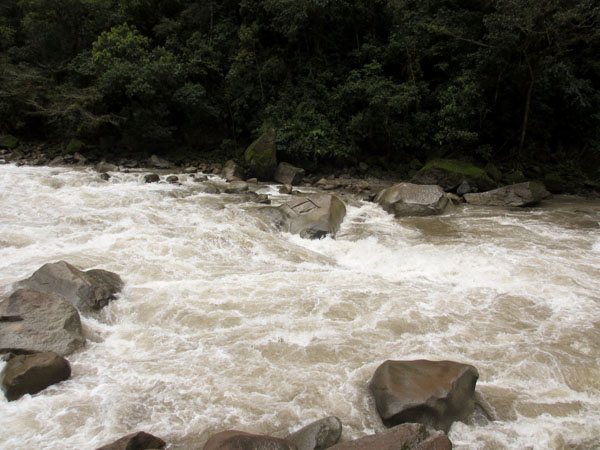
Today, April 24, we took the 2.5 hour early morning train ride from Ollantaytambo to Aguas Calientes. The very comfortable train goes along the swift and turbulent Urubamba River all the way to Aguas Calientes.

bimg_0815a

From the train I caught brief glimpses of Torrent Ducks, an Andean Guan, a Fasciated Tiger Heron and an Andean Motmot. At Aguas Calientes we met our Machu Picchu guide, Vilma, and took the short bus ride up to the ruins, arriving there on a beautiful sunlit morning.

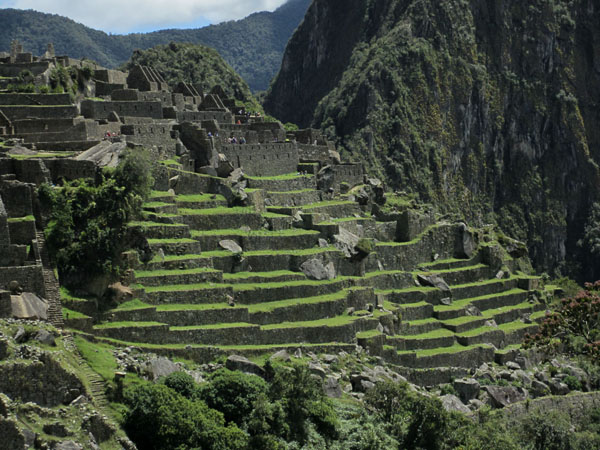
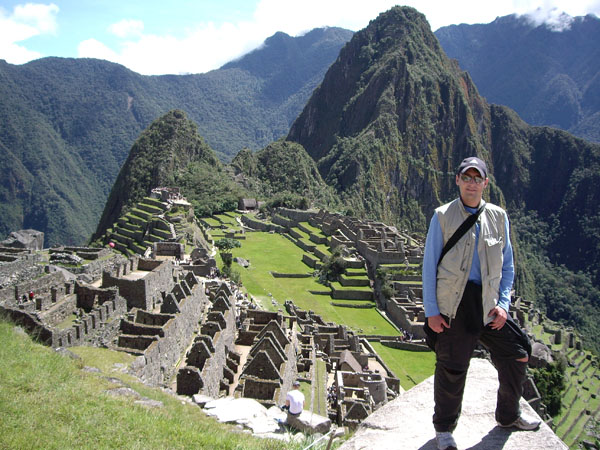
I had been told, but I was not prepared for the beauty of Machu Picchu. It does not look like a “ruin”. The buildings and terraces were constructed in the 1500s to house a city of about 800 Incans.

bimg_0772a

They lived there only a short time before it was abandoned due to the fears of the on-coming Spaniard Conquistadores, who in fact did not find it. It was “rediscovered” only about 100 years ago by a National Geographic photographer, Hiram Bingham. Pictures are better than words at conveying the loveliness of this place. I walked about half way to the top and then found a shady spot to stop while Adam and Vilma went on to the top.

bimgp7633

I sat in the shade and mused about the history and spirit of the city and its founders, looking out over the buildings and terraces and the amazing mountains that surround the site. Blue and White Swallows, White-tipped Swifts and a lone American Kestrel, soared around me.

We met Silverio at the Machu Picchu cafeteria, in the Sanctuary Lodge Hotel, for lunch. This is a cafeteria to challenge all cafeterias. The food quality and selection were outstanding. After lunch we boarded a bus and returned down to Aguas Calientes where we rested until dinner time.

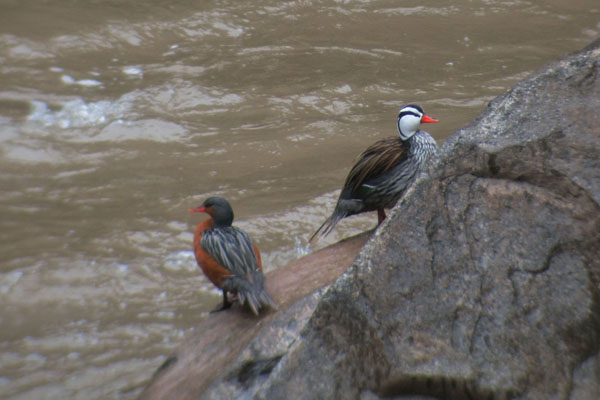
The next morning, April 25, we took the bus half way back up the mountain toward Machu Picchu and were let off by the Urubamba River. From there we spent a leisurely morning birding our way back through the trees to Aguas Calientes along the rail road track and the Urubamba River. This was the most productive morning of birding of the entire trip. We had nice weather, the walking was easy and the birds were plentiful. Among the best sightings were spectacular looks at Torrent Ducks

bimg_0801a

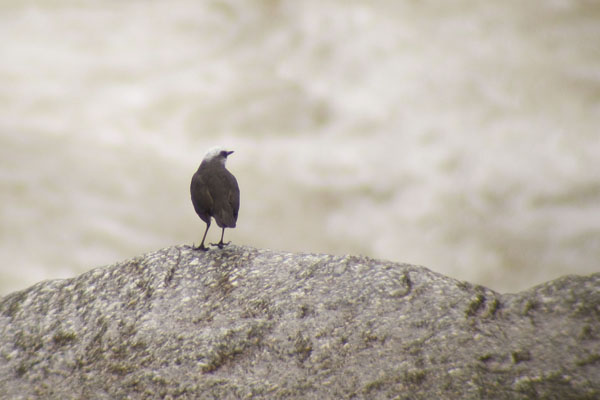
and a White-capped Dipper on rocks in the Urubamba.

bimg_0814a

Along the way we saw an excellent sampling of Peru’s many Tanagers, including: Oleaginous Hemispingus (another one of these delightfully named birds), Rust and Yellow Tanagers, Blue-Gray Tanagers, Palm Tanagers, Blue-capped Tanagers, Fawn-breasted Tanagers, Saffron-crowned Tanagers, Golden-naped Tanager, Silver-backed Tanagers, and Blood-red Tanager. Hummingbirds were also present : Green Hermits (one very close), a spectacular Long-tailed Sylph, a Chestnut-breasted Coronet, a Booted Racket-tail, and Green and White Hummingbirds. Other birds seen along the way included Andean Guans, a Fasciated Tiger Heron, Versicolored Barbets, Ocellated Piculets, Mitred Parakeets, Variable Antshrikes, a Streaked Xenops, Sclater’s Tyrannulets, an Ashy-headed Tyrannulet, a White-crested Elaenia, Mottled-cheek Tyrannulets, a Streak-necked Flycatcher, Black Phoebes, Golden-crowned Flycatchers, Tropical Kingbirds, Red-eyed Vireos, a Brown-capped Vireo, Gray-breasted Wood-Wrens, a Capped Conebill, Masked Flowerpiercers, a Chestnut-capped Brush Finch, a Tropical Parula, Slate-throated Whitestarts, and Russet-crowned Warblers.

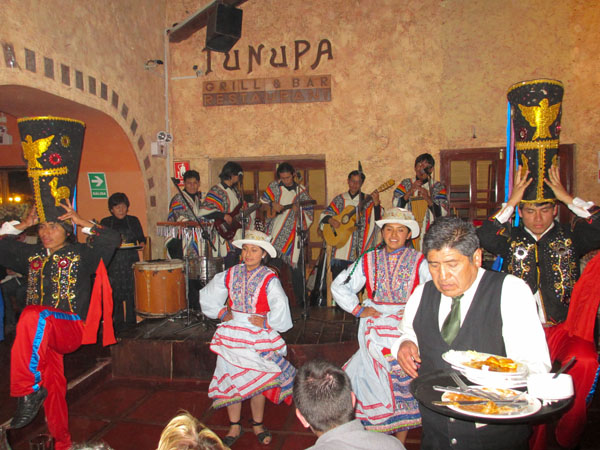
We lounged around (slept) in the lobby of our hotel until the train departed from Aguas Calientes to Cusco, where we would spend the night before flying back to Lima the next day. The train ride was about 4 hours, but it was enlivened by a mischievous masked creature and a fashion show along the way. That night in Cusco we dined at a very nice cafeteria, where we were again entertained, this time by a traditional Andean band and dance group.

bimg_0839a

The next morning, April 26, our return was complicated because a large crowd was demonstrating on the streets outside our hotel and made it impossible for our driver to get to the hotel to take us to the Cusco airport. We walked a few blocks to connect, and made our flights back to Lima and the U.S. in fine shape.

Conclusions: Peru is a beautiful country. If you like scenery, go there. The mountains are unmatched. Machu Picchu lives up to its reputation as one of the great historical attractions of the new world. It is well maintained and well run. If you want to see a lot of large and colorful birds, the Cusco, Abancay, Abra Malaga and Machu Picchu area is not the best choice in Peru. It does harbor some nice endemics and other interesting birds. Our final tally for the approximately 5 days of birding was 117 species seen, almost all of which were new to me.

Peru Birding – April 2012 – Part 2

We rose early on April 21 for a pre-dawn start, and skipped breakfast to try to catch the morning appearances of several of the birds found best, or only, near Abancay.  We drove in the dry Apurimac Canyon on the road to Andahualas (below Abancay) and stopped frequently along the river after crossing the Sahuite Bridge. Here we saw quite a few White-tipped Doves and Andean Swifts, Tyrian Metaltails, a Shining Sunbeam, White-bellied Hummingbirds, and, as we were about to head back to town for breakfast, 2 of our primary targets, Creamy-breasted (Pale-tailed) Canasteros.  Adam spotted a lovely Black-backed Grosbeak from the van, and we saw another a little later on.

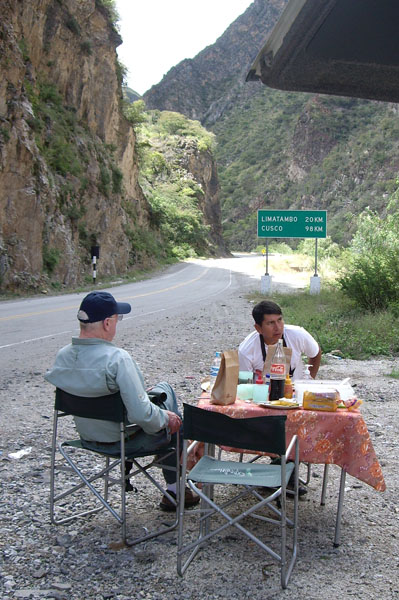
After breakfast we began our journey toward the Sacred Valley of the Incas, and the tourist mecca of the area, Ollantaytambo.  Along the way we spent a considerable time looking for the extremely elusive Ampay Tapaculos, without success, although at least 3 individuals were heard.  Along the way we stopped for a late lunch off-road on a nicely secluded hillside on a high pass, where we spent several hours enjoying the scenery, the pleasant weather and the abundant bird life.  It was here that we saw one of the only 2 wild mammals of the trip: a Montane Guinea Pig.  (The other was a Mountain Viscacha, seen during our lunch stop the day before).  The area was quite open, so for the most part, the birds that were present could be seen, except for the vocal Antpittas, who stayed under cover.

Among the birds seen today were Black-chested Buzzard Eagles, a Mountain Velvetbreast, a White-bellied Woodstar, Cream-winged Cinclodes (fairly common), a Rusty-fronted Canastero (Adam only), a Black-billed Shrike Tyrant, Red-crested Cotingas, common old Red-eyed Vireos, a beautiful Rust and Yellow Tanager, a Blue and Yellow Tanager, a Scarlet-bellied Mountain Tanager, Cinereous Conebills, Black-throated Flowerpiercers, Peruvian Sierra-finches, Plain-colored Seedeaters, Golden-billed Saltators, and an Apurimac Brush-finch,

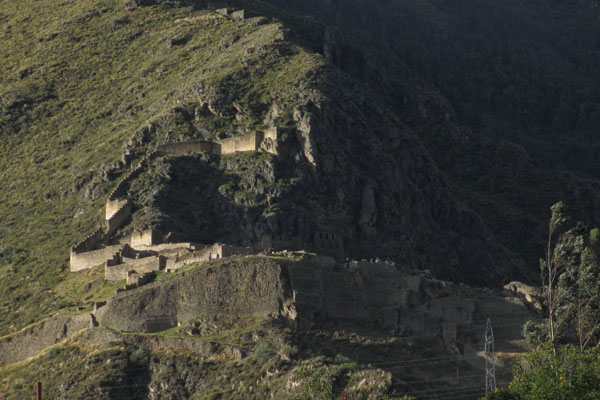
After a long day on the road, we arrived at Ollantaytambo and our Lodge, the very nice Pakaritampu Hotel, where we would spend three nights.  The contrast between Abancay and Ollantaytambo was very distinct.  I was glad that we were spending 3 nights at Ollantaytambo, not at Abancay.  Among other attractions, Ollantaytambo is the site of the second most noted Incan ruin in Peru.  We did not make the trip up to the ruins, but we enjoyed the view.

bimg_0756a

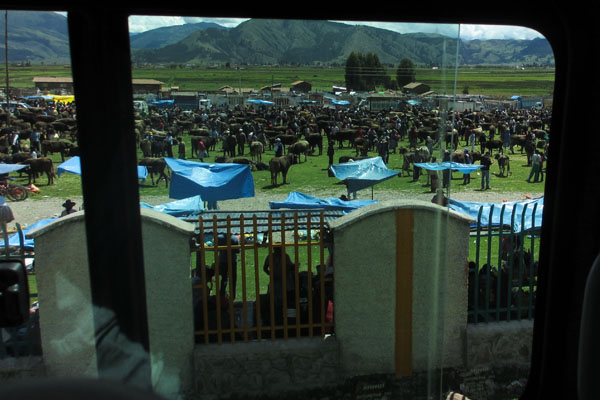
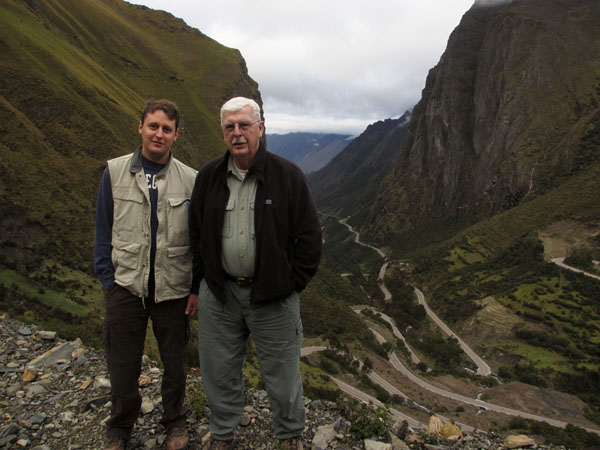
The next day, April 22, proved to be one of the most physically challenging days of my life.  I had questioned Silverio at dinner the night before about the difficulty of the hike down the west slope of Abra Malaga.  He left it up to me, and I decided to give it a go.  That was a mistake.  We drove from Ollataytambo up to the top of Abra Malaga, about 14,000 feet.  The drive was spectacular, with the beautiful mountain scenery.  Along the way we saw a cattle auction.

bimg_0705a

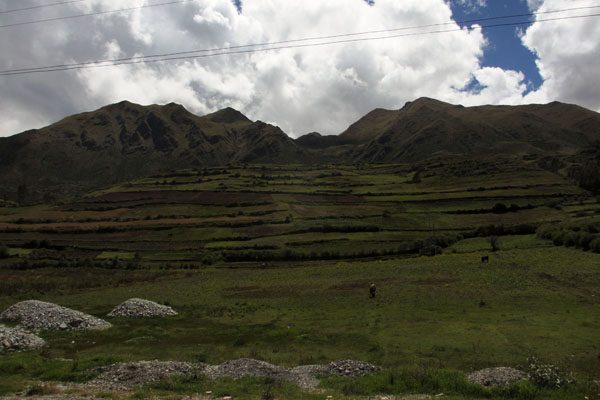
According to Silverio, a good bull (and all the males remain bulls) is worth about $500.  The ancient methods of agriculture are still practiced on the terraced steep mountain sides.

bimg_0709a

Not much room for tractors to turn around.  Thus, the importance of beasts of burden such as the bulls and the burros.

The design of the road should have been a tip-off as to the difficulty of the descent to follow, but I was oblivious.

bimg_0724a

The weather wasn’t very good.  Mist, wind and sporadic rain greeted us as we began our descent from the top of Abra Malaga.

bimg_0737a

There were some nice birds at the top, including 2 impressive Andean Flickers, and a Streak-throated Canastero.  We started down about 7:30 a.m., on what was billed as a 4 hour hike.

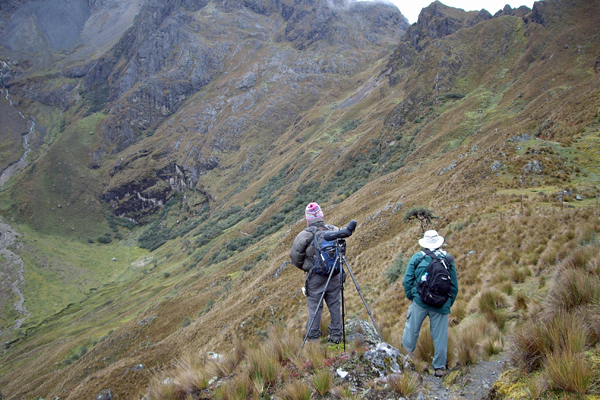
Fast forward, we finally got down 8 hours later, about 4:00 p.m., for “lunch“. Toward the end, my knees were nearly gone, and but for my decision to take my cane and wear knee braces, I would not have been able to walk out.  I crashed on my rear-end three times on the rain-drenched grass slopes, in the mud.  Thankfully, we were past the narrow mountain paths by then.  We nearly lost Adam as he careened down hill trying to catch his footing, coming to a halt stuck in a big mud hole, but standing tall.

As we left the treeless top of west slope of Abra Malaga we entered the Polyepsis woodlands, one of the few remaining in the world.

bimgp7518_edited-1

These are very short trees, with distinctive trunks and branches.  The Polylepsis contains some of the rarest birds in Peru.  I was very happy, after hours of searching the prior day, to finally see a Tapaculo, specifically a Puna Tapaculo.  This secretive, drab little bird walked out into an opening in the Polylepsis trees down-hill from us and I was greatly relieved that the pressure to find a Tapaculo was now off.

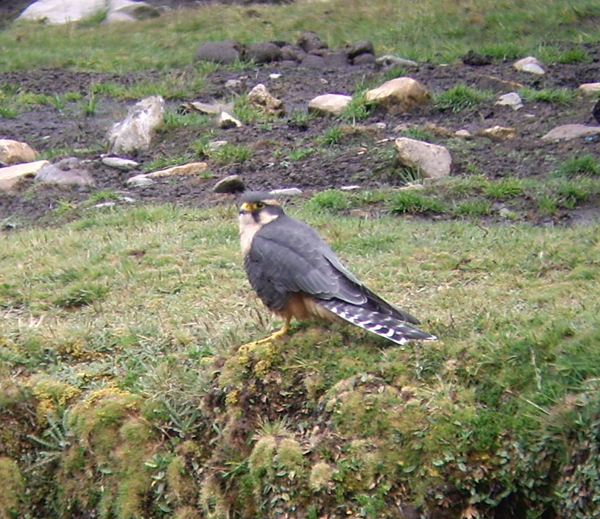
Among the birds that we saw during this marathon hike were Mountain Caracaras, Aplomado Falcons,

bimgp7544_edited-1

Andean Parakeets, an Olivaceous Thornbill, a White-browed Tit-spinetail, a Line-fronted Canastero, a Stripe-headed Antpitta, a rare and endangered Ash-breasted Tit-tyrant, Rufous-breasted Chat-Tyrant, Brown-backed Chat-Tyrants, D’Orbigny’s Chat-Tyrants, Rufous-naped Ground Tyrants, a Puna Ground Tyrant, Cinereous Ground Tyrants, and Plumbeous and Ash-breasted Sierra Finches. Actually, quite good in retrospect.

I was famished, exhausted and in pain by the time we exited the Valley and arrived at the van.  We devoured our late lunch and headed back to the hotel. Between my knees and Adam’s apparent altitude sickness, we had a bad night, but by morning, April 23, we were ready to go again, provided we stayed in or near the van and all walking was on a nearly flat road with the van close by and on call.  With those limitations, we actually had a good day of birding.  This time we went back up to the top and explored the east slope of Abra Malaga.

We missed a couple of the birds that I had hoped to see here: Andean Goose and Puna Ibis.  The weather, again, was not good.  There was a lot of fog (Neblina), and sporadic rain.  But we did get good looks at a lot of interesting birds today, either on the east slope of Abra Malaga or on the road back to Ollantaytambo. These included a nice flock of Yellow-billed Teal, good looks at a Variable Hawk, more Andean Lapwings, a spectacular Sword-billed Hummingbird, Cream-winged Cinclodes, a beautiful White-tufted Sunbeam, and an equally beautiful Great Sapphirewing, Puna Thistletails, Marcapata Spinetails, Rufous-breasted Chat-Tyrants, Brown-bellied Swallows, Spectacled Whitestarts, Citrine Warblers, a Paramo Pipit, Parodi’s Hemispingus (I love that name), more Scarlet-bellied Mountain Tanagers, White-browed Conebills, and both Black-throated and Masked Flowerpiercers, as well as the abundant Rufous-collared Sparrows.

Back at the hotel, I had time to bird the grounds and was pleasantly surprised to find a nice variety of birds right on the hotel grounds.  These were Spot-winged Pigeons, Sparkling Violet-ears, Green and White Hummingbirds, White-bellied Hummingbirds, and a female Rusty Flowerpiercer.

Peru Birding – April 2012 -Part 1

I arrived in Lima, Peru, about midnight on April 18th. The next day I hired a local city guide recommended by my hotel. That afternoon she, with a driver and me, toured some of the more historic or scenic parts of Lima. The Miraflores District was lovely, and the views of the ocean were interesting, if somewhat hazy. More interesting was the old city of Lima. My favorite place there was the Franciscan Abbey. The Abbey is a storehouse of the history of Peru from the Spanish conquest in the 1530s to the present day. I especially liked the old library with its thousands of ancient volumes. I wonder what sorts of information they contain. The catacombs, where almost 500 years worth of Franciscan monks and friars are buried, were dark and humid, not a place to linger. The library and the catacombs have in common their “VOB stacks”: one of Very Old Books and one of Very Old Bones. Dank and dusky volumes of forgotten lore and lives. We drove back to my hotel during rush hour, which is not an experience I wish soon to repeat. The traffic pendulum swung from tedious to terrifying, with little moderation in between.

Incidentally, for one arriving alone at the Lima airport I recommend the hotel where I stayed: the Costa del Sol Ramada. It is just a few feet from the baggage claim area at the airport, easily and safely accessible by foot. Their breakfasts were excellent and the dining room fare was very good. A bit of a steep price, but in perspective, worth it.

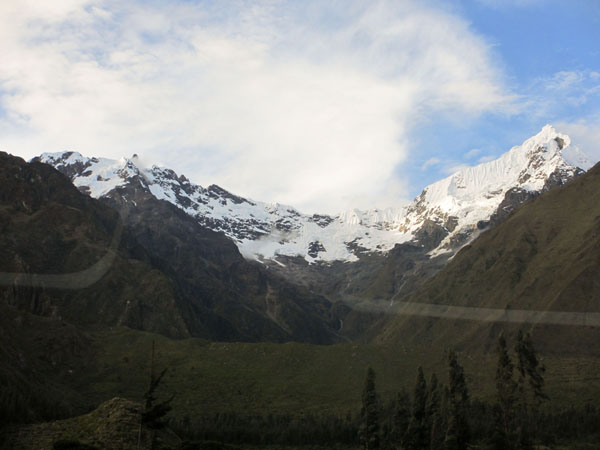
Adam arrived on schedule late that night, the 19th. We left for Cusco on Star Peru Airlines at 8:00 the next morning. We were met at the Cusco airport by representatives of our guide service, Manu Expeditions. After brief introductions, we left by van for Abancay with our guide, Silverio Duri, and our driver, Guillermo. We were impressed with the beauty of the snow-capped Andes ( I didn’t expect so much snow)

bimg_0826a

and the lovely green valleys and mountain sides.

bimgp7555_edited-1

We stopped for lunch along the road, by the Apurimac River.

bimgp7416_edited-1

We did not do a lot of birding this first day, because the drive to Abancay was long-very long. When we finally arrived at Abancay we found an old city, with not much in the way of tourism. Many people were in the streets celebrating the end of the week. To my surprise, although it was dark by the time we arrived, we drove on through the town, and turned off on a very poor and isolated road. This was to be the site of our search for one of our target birds for the Abancay area: the Apurimac subspecies of Koepcke’s Screech Owl. Silverio was optimistic that it would be found. I had doubts.

We finally came to a stop, of necessity, at the end of a closed-off bridge across the fast flowing Apurimac. Silverio hoped to find The Owl near where we stopped, but nothing turned out easy on this trip. To quote Silverio’s trip report: “Oh yes! We were initially slightly worried about this guy because almost as soon as we arrived to “Pachachaca” bridge below Abancay, I played the tape and one of them responded very close to us but we couldn’t find it and at the same time stopped calling, so then I kept playing and not more responses, that is why I decided to go back to the vehicle and onto a different spot but just before I got inside the van I tried again . . . And almost right away two of them responded and one of them came into plain view where we got great views. These Apurimac birds may represent an undescribed subspecies – slight vocal differences between these and the northern Peruvian populations, and they tend to ignore playback of the northern calls.”

Silverio graciously omits the full scenario: after a long hike, in the dark, away from the bridge to try to find the Owl, and before getting in the van, I needed a rest-stop, and while I was thus engaged, the others spotted the Owls. Because I was otherwise occupied, I failed to see them. Silverio was exasperated; how could I have missed this prize? Fortunately, one returned just as I re-joined the group, and Voila, the long day did not end in total disaster. I saw, and saw quite well, the (potential) Apurimac Subspecies of Koepcke’s Screech Owl. Of course, this provoked a theme for the trip that I was never able to live down.

We returned (slowly, slowly) to Abancay and our (old) Hotel de Turistas, where we were served a very late but decent and, by then, much needed meal in the Hotel Dining Room.

We did see a few other birds on this first day, during a few stops along the way: Black-chested Buzzard Eagle, Variable Hawk, Andean Lapwing, Andean Swifts (overhead as we stopped for lunch along the river), Tyrian Metaltails (a hummingbird), Mitred Parakeets, Tufted Tit-tyrants, a very lovely Red-crested Cotinga, Chicanguo and Great Thrushes, Peruvian Sierra Finches, Chestnut-breasted Mountain Finches, Plain-colored Seedeaters, Golden-billed Saltators, Rufous-collared Sparrows (many), and Hooded Siskins.

Panama Birding – Canopy Lodge

We spent three nights at Canopy Tower and then we were driven in a Canopy vehicle to the sister birding camp, Canopy Lodge. This took about 3 hours. Canopy Lodge is located west of Panama City on the line between the Chocle and Panama provinces (or whatever the governmental divisions in Panama are called).

The location is higher, cooler and, at least while we were there, wetter than the area nearer Panama City. The countryside is very beautiful. We were not aware how hilly and mountainous Panama is away from the coast line. Canopy Lodge is located in the El Valle area, primarily foothill forests . For many years, this has been a week-end retreat for residents of Panama City seeking to relax in a quieter, cooler and drier clime.

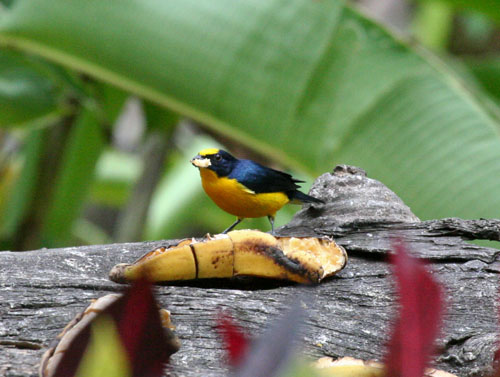
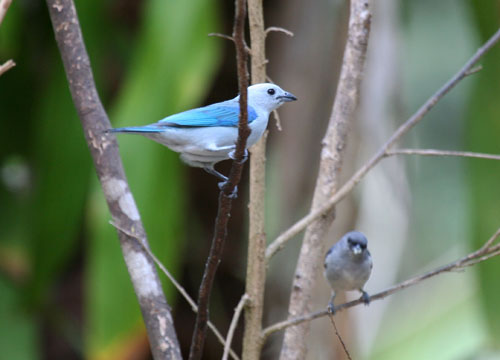
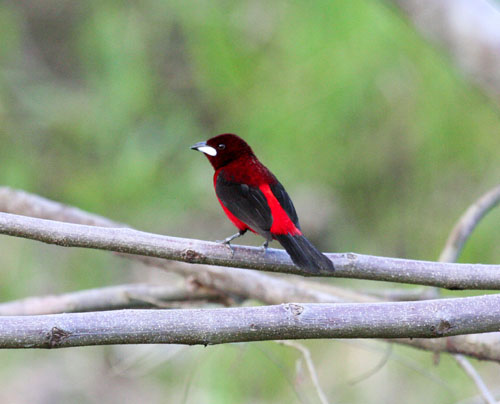
The rooms at the Lodge are a lot nicer than those at the Tower. The grounds are much more expansive. There are feeding stations located off the open-air dining area (where all meals are taken) and these are regularly replenished with bananas to attract a variety of birds. Surprisingly, there was very little hummingbird activity at the Lodge notwithstanding the presence of a couple of hummingbird feeders. The only species I saw during my stay were Snowy-bellied Hummingbirds and Rufous-tailed Hummingbirds. Other species that showed up at or under the banana feeders included Blue-gray Tanagers, Crimson-backed Tanagers, Palm Tanagers, Flame (Lemon)-rumped Tanagers, Thick-billed Euphonias,

thick-billed-euphonia

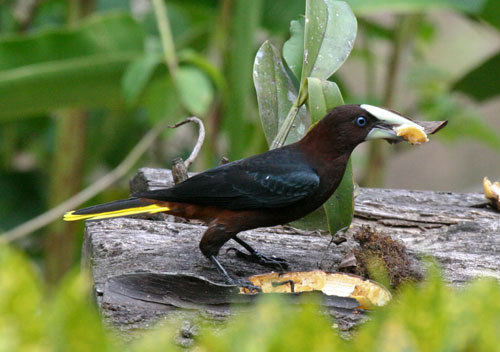
Tennessee Warblers, a Prothonotary Warbler, Red-crowned Woodpeckers, Clay-colored Thrushes, Chestnut-headed Oropendolas,

oropendola

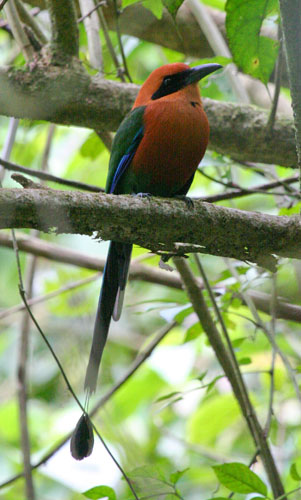
House Wrens, White-tipped Doves, Red-legged Honeycreepers, and, on the last day and much to our surprise, a strikingly plumaged Rufous Motmot.

rufous-motmot

Our guide here was Moyo. He is knowledgeable and enthusiastic. As at the Tower, the guides at the Canopy Lodge are simply amazing in their knowledge of the local flora and fauna and in their enthusiasm in showing it all to their guests. We normally left with our guide after breakfast, about 7:15 and returned in time for lunch at about 12:30. After lunch and a siesta, or a walk around the grounds, we would go again with our guide about 3:00 and return at around 6:00. There are various routes that can be covered, and we were not there long enough to take them all.

Among the more colorful or interesting birds that we encountered during these field trips were Tawny-capped Euphonias,

tawny-capped-euphonia

a Rufous Mourner,

rufous-mourner

a tiny and cooperative Streak-throated Hermit,

streak-throated-hermit

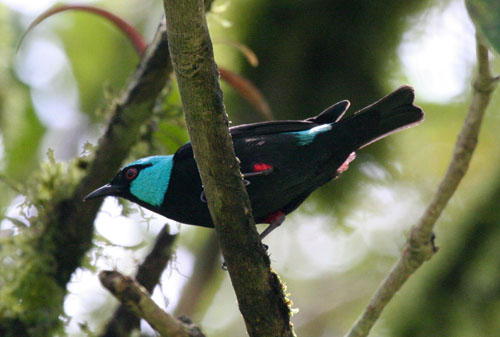
Scarlet-thighed Dacnis,

scarlet-thighed-dacnis

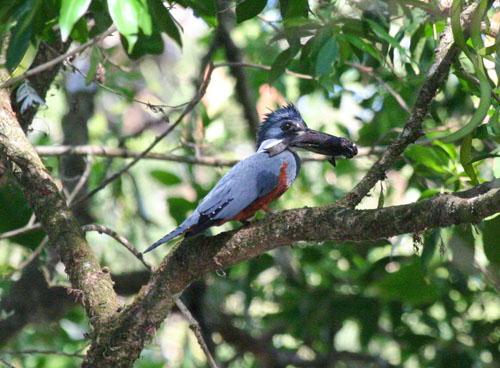
a big Amazon Kingfisher with fish,

amazon-kingfisher

cute little Lance-tailed Manakins,

lance-tailed-manakins

a White-bellied Antbird,

white-bellied-antbird

Garden Emeralds,

garden-emerald

Orange-bellied Trogons,

orange-bellied-trogon

and a Blue-throated (Emerald) Toucanet.

blue-throated-toucanet

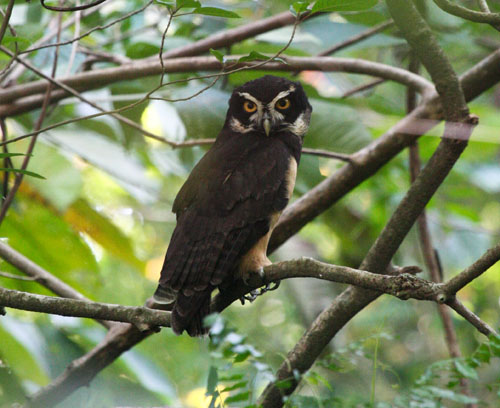
My favorite spot of the trip was the lovely and rare Spectacled Owl.

spectacled-owl

We saw five of the six Trogons that can be seen in the area (missing only the White-tailed Trogon), all of the five Manakins and all of the four Motmot species. We saw a good sampling of the Antbirds, Antshrikes, Antwrens, Antthrushes and Antpittas the dwell in the forests of Panama. Other families well represented were the Wrens, Tyrant Flycatchers, Hummingbirds (we saw 11 species), and Woodcreepers. Surprisingly few were the Parrots and Parakeets.

My final Panama bird tally was 81 new species and 211 total species. Panama is a beautiful country and it is great for birding. Anyone who has the opportunity to go there, should. There are many more areas of the country that could be explored with equally bountiful numbers of species.

Birding in Panama – Canopy Tower

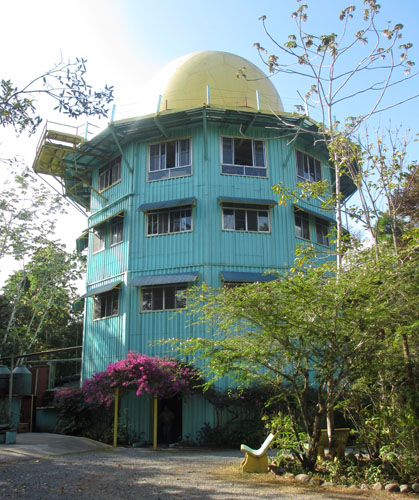
Canopy Tower is an abandoned U.S. Army radar station, built like a very wide silo.

canopy-tower

When the military abandoned it, it was converted into a destination birding site with rooms and common areas for 20 or so guests, great views of the surrounding jungle from the top of the Tower and excellent guides to help guests identify the numerous Panamanian species that can be found in the area.  We spent the afternoon and the next 2 days on guided tours to various sites in the vicinity of the Tower, including the famous Pipeline Road.

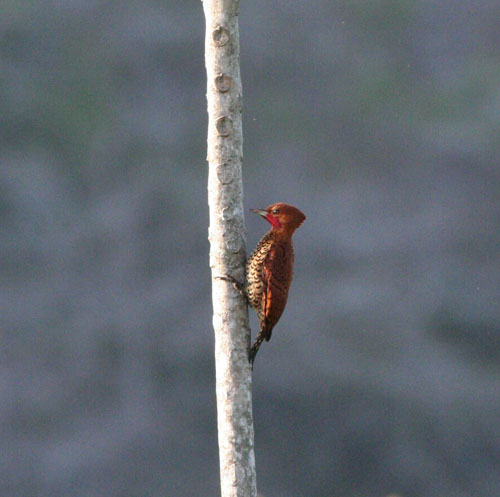
The most colorful birds that we saw well from the Tower itself were the Cinnamon Woodpeckers.

cinnamon-woodpecker

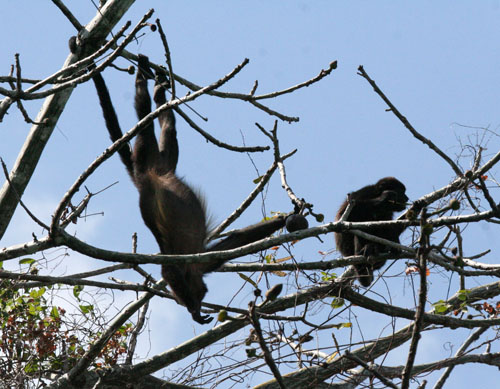
Early every morning we were awakened by the howling of the Howler Monkeys, which occasionally came very near the Tower.

howler-monkeys

Blue-gray Tanagers were the most numerous of the many species of tanagers that we saw.

blue-gray-tanagers

Crimson-backed Tanagers were among the most colorful and were also quite numerous.

crimson-backed-tanager

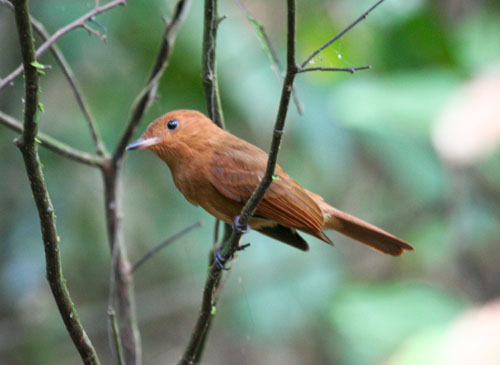
One of the least expected finds for me was the strangely named “Brownish Twistwing.” The name comes from its habit of constantly twisting first one and then the other of its wings.

brownish-twistwing

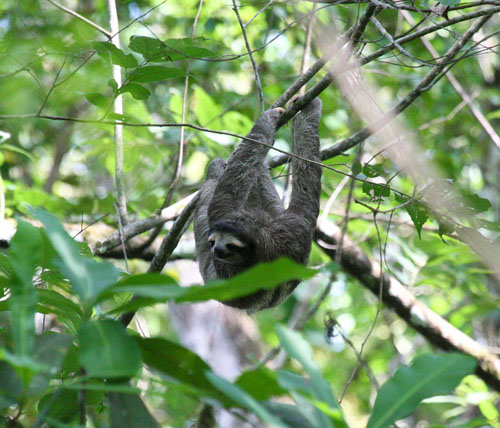
We saw several slothful Brown-throated Three-toed Sloths, resting motionlessly high in their tree-top perches.

three-toed-sloth

We later saw several of the somewhat larger Hoffman’s Two-toed Sloths, but they were curled up and motionless and never exposed their more memorable features sufficiently to get a good picture, unless you think an amorphous mass of gray hair is of interest.

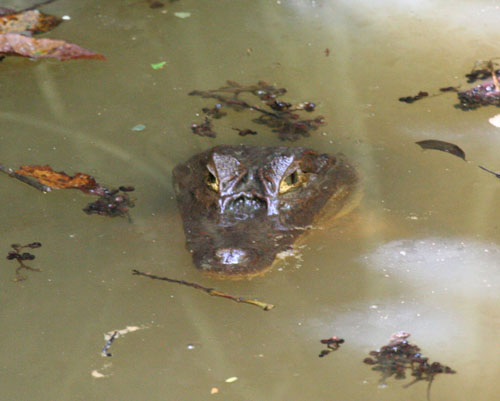
On Sunday morning we walked on Pipeline Road, where we met our Panamanian friends again as they were out for a run.  We also met up with this rather menacing Cayman, glaring at us from a small pool along the Road, as if to say “if you come here at night I will be waiting.”

cayman

We learned that the Pipeline Road was built to supply oil to the Canal through a pipe laid along the road, which has never been used.  The road does provide a nice running track and nature trail, and is known world-wide for the variety of birds that can be found along it.

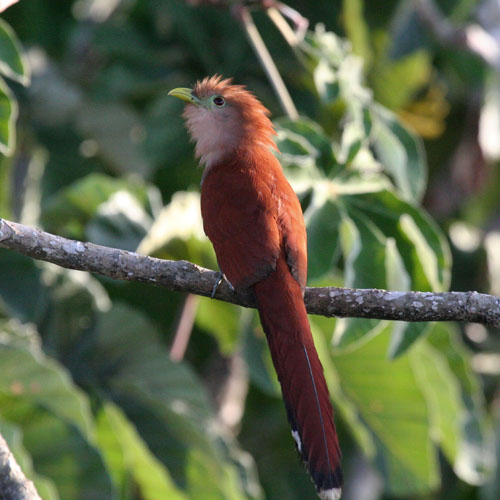
Among the other colorful or interesting birds that we found on our trips from Canopy Tower were a Black-throated Trogon,  a Squirrel Cuckoo,

squirrel-cuckoo

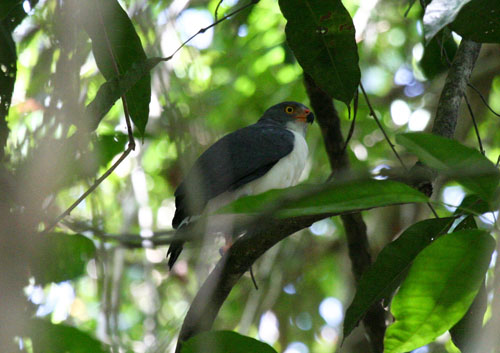
a Semi-plumbeous Hawk,

semi-plumbeous-hawk

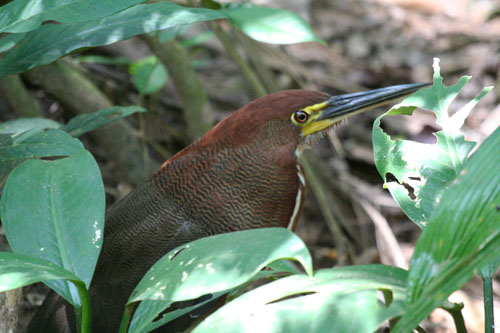
and a Bare-faced Tiger Heron.

bare-faced-tiger-heron

From Canopy Tower we were taken by van to its sister facility, Canopy Lodge, on the border between the governmental departments of Panama and Chocle, for three more days of birding and general nature appreciation.  I will describe the Lodge and what we saw and did there in my next installment.

Panama City, Panama

Barbara and I arrived at Panama’s Tocumen Airport about 10:00 p.m. on March 7th where we were met at the baggage area by a driver arranged for by our hotel, the Radisson Summit Hotel and Golf.  The ride to the hotel was quite long, but it was worth it because the Summit is a lovely place and is not very expensive, especially if, like us, you do not golf.  We enjoyed our first night, breakfast the next morning, and a little early morning birding around the expansive hotel grounds before hitching a ride on the hotel’s van for a mid-morning and early afternoon walking excursion in the Old City.

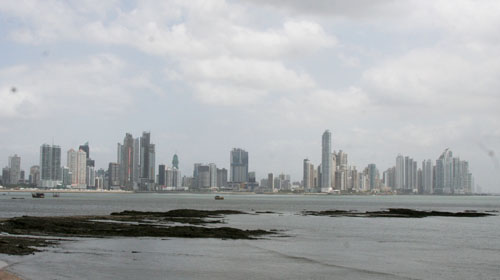
The Old City was cramped but interesting.  We walked around for a couple of hours.  We had a good view of the skyline of the new Panama City across the harbor.  It is very impressive, with some of the most spectacular high-rise architecture that we have seen anywhere.

skyline

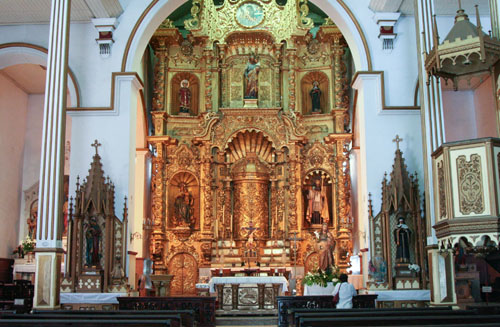
We visited Iglesia of San Jose with its spectacular golden altar.

golden-altar

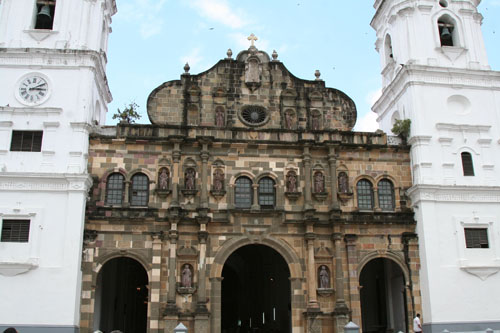
We quickly left the cathedral when we became aware that a funeral was about to begin.

cathedral

The entire area is involved in a great deal of renovation.  The completed structures are stunning.

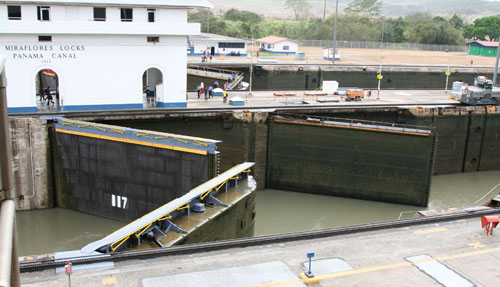
We took a taxi from Old City to Miraflores for lunch and an afternoon watching the great ships (the “Panamax” vessels) ease through the Canal, never on their own power, but towed by several cable machines.

canal-1

The clearance between the sides of the ships and the sides of the Canal could not have been more than a few inches.

canal-2

Across the Canal we saw the dirt-moving and other activity involved in building a parallel and wider Canal to accommodate the even wider ships that are now being produced.  It is projected to be completed by 2014 for the 100th anniversary of the Canal.

The Canal is still one of the engineering wonders of the world.

canal-3

The French started a canal in 1880 under the direction of the builder of the Suez Canal, but after 20 years of struggle, they were forced to give up.  In 1903 Panama seceded from Columbia and the US signed a treaty in which the concession for a public maritime transportation service across the Isthmus was granted.  The following year the US purchased the French company’s properties for $40 million and began to dig.  On August 15, 1914, a US cargo ship made the first transit.  In October 1979 the process of handing the Canal to Panama began under treaties signed by President Carter.

The Canal is about 50 miles long and ships are lifted 85 feet in three locks as they cross the Isthmus.  The journey through the Canal takes about 8 hours and a ship is normally in Canal waters between 14-16 hours.

From Miraflores we took a taxi back to our hotel and later we were met there by friends from Panama.  They drove us back down town to the new city and we thoroughly enjoyed a very lovely evening with them at one of their favorite neighborhood restaurants.

The next morning the Canopy Towers van picked us up at the Summit Hotel and drove us the short distance to Canopy Tower.